


You can tell good-quality stainless steel jewelry by checking the stated material, inspecting the finish and construction, and confirming that care claims apply to the exact piece. A shiny surface or a stainless steel stamp alone does not prove quality. For your 2026 shopping checklist, put smooth edges, secure closures, clear material descriptions, and comfortable fit ahead of big promises.
- How to tell good quality stainless steel jewelry: check material details, smooth finishing, secure closures, and piece-specific care.
- GRISÉ NYC offers stainless steel jewelry and mixed-metal designs; assess each piece's materials rather than assuming identical care.
- 18k gold-plated stainless steel is not solid gold; inspect the base metal and surface finish separately.
- A magnet, heavy feel, or shiny photograph cannot establish stainless steel jewelry quality on its own.
Why this matters
Bold jewelry should make getting dressed more fun, not leave you fighting a clasp or dodging a rough ring edge. Quality means the piece is clearly described, well finished, and practical for how you wear it. Appearance is only part of that decision.
When browsing GRISÉ NYC, separate the design you love from the construction details you need to check. A sculptural ring, pearl necklace, and gold-plated bracelet need different questions. Your 2026 buying decision should follow the individual description, not a blanket assumption about everything labeled stainless steel.
How do you know if stainless steel jewelry is good quality?
Use this inspection sequence online and again when the jewelry arrives. Start with the description, then check the parts that touch your skin and keep the piece attached.
1. Read past the word steel
Look for an explicit statement that the jewelry is stainless steel. A silver color describes appearance, not metal composition, and a gold color does not establish whether a piece is plated or solid gold.
A named grade such as 316L adds specificity. It does not prove that every edge, clasp, or setting is well made. Material information and workmanship are separate checks.
For mixed-material pieces, identify the extras too: freshwater pearls, imitation pearls, cubic zirconia, enamel, and resin are not interchangeable descriptions. Those details affect both what you are buying and how you should care for it.
2. Inspect the edges and underside
Check the inside of rings, the backs of pendants, earring posts, and bracelet openings. These surfaces deserve the same attention as the front because they touch your skin or clothing.
Look for smooth transitions rather than burrs, sharp seams, or exposed points. For deliberately rugged designs, distinguish visible texture from uncomfortable finishing. A hammered face is a style choice; an abrasive inner band is a reason to stop and inspect.
3. Test closures without forcing them
Open and close the clasp or earring fastening gently. It should engage securely rather than leave you guessing whether it caught.
Inspect the connecting rings beside the clasp as well. A handsome chain still depends on those small connections. Look for unintended gaps, distorted links, or a closure that catches instead of operating cleanly.
Do not pull hard to prove strength. You are checking normal function, not performing a destructive test.
4. Check stones, pearls, and decorative details
Examine settings from the front and side. Look for a visibly loose stone, an uneven attachment, or an exposed edge that catches fabric.
Irregularity is not automatically a defect. Baroque pearls and intentionally organic metalwork are designed around uneven shapes. Compare the piece with its description and photographs before treating asymmetry as poor workmanship.
The useful distinction is intentional shape versus insecure construction. A flowing silhouette belongs in the design; a moving setting needs attention.
5. Judge the finish on its own terms
Polished jewelry should have a consistent finish appropriate to its design. Matte, hammered, and weathered surfaces should match the intended look rather than resemble accidental damage.
For plated jewelry, inspect corners, edges, and contact areas for visible patchiness or exposed base metal on arrival. Do not confuse a two-tone pattern with worn plating: check where each color belongs in the listing.
Photographs help you compare the design. They cannot establish coating thickness, metal composition, or long-term wear performance.
6. Try ordinary movements
Close your hand while wearing a ring. Turn your wrist in a cuff, and check how earrings sit when you move your head.
A piece can look great and still be wrong for your routine. Notice pinching, awkward pressure, hair catching, and interference with sleeves. The best everyday piece is the one you can wear comfortably, not the one you keep adjusting.
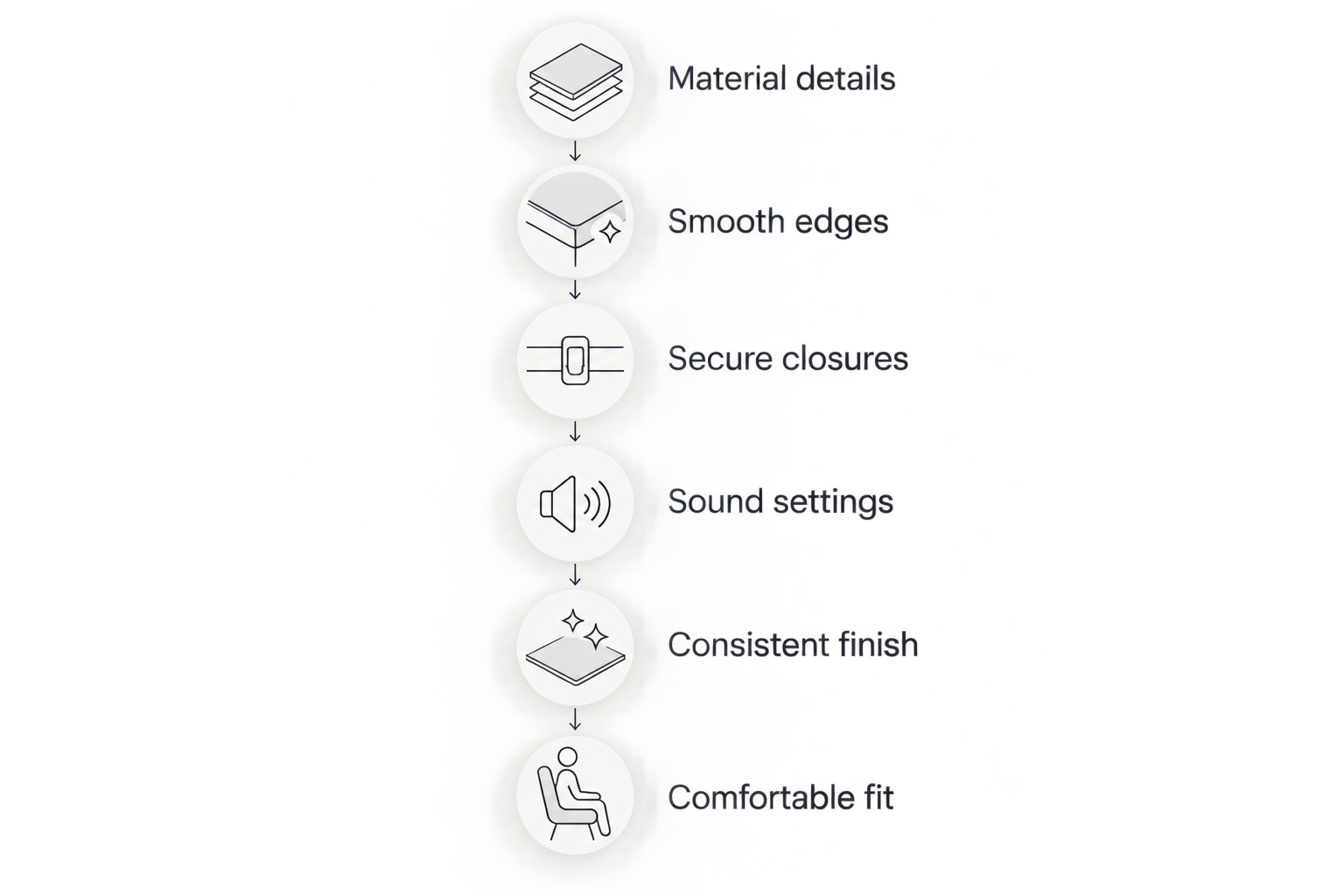
These checks form a practical sequence: Material details, Smooth edges, Secure closures, Sound settings, Consistent finish, Comfortable fit.
Unplated stainless steel: best for a steel-colored look
Unplated stainless steel is best for shoppers who want the metal's own steel-colored appearance rather than a gold-colored coating. Its appeal is straightforward: you are not choosing it for a separate gold layer.
The trade-off is that stainless steel is not scratch-proof. A durable material still deserves sensible handling, and polished surfaces can show marks from wear.
Do not treat stainless steel as a universal skin-safety guarantee either. Stainless steel alloys can contain nickel, and an individual reaction requires more information than the category name supplies. Known metal sensitivity belongs on your buying checklist before style preferences.
Gold-plated stainless steel: best for gold color over a steel base
18k gold-plated stainless steel is best for shoppers who want a gold-colored finish over stainless steel, not solid gold construction. The 18k description refers to the gold used in the plating; it does not mean the whole piece is 18k gold.
The trade-off is the surface layer. Plating can wear through friction and exposure, so the steel underneath and the coating above it need separate consideration.
For your 2026 comparison, look for clear language identifying both layers. Do not assume that a gold-colored piece has a particular plating thickness, application method, or lifespan unless the seller states it.
Two-tone stainless steel: best for mixing your metals
Two-tone jewelry is best for connecting silver-colored and gold-colored pieces in the same outfit. It gives you a visible reason to wear both finishes together without replacing what you already own.
The trade-off is that different areas can have different surface treatments. A steel section and a gold-plated section should not automatically inherit identical care claims.
Try a two-tone chain with your existing silver-colored hoops and a gold-colored ring. Keep the shapes simple if you want the color contrast to do the talking.
Why stainless steel jewelry quality varies
Material is only one part of the finished piece. These details explain why two stainless steel designs deserve separate inspections:
- Finish: Polished, textured, and plated surfaces need different visual checks.
- Construction: Clasps, connecting rings, posts, and settings determine how the assembled piece functions.
- Added materials: Pearls, enamel, resin, and stones introduce their own care considerations.
- Shape and fit: A wide ring or sculptural cuff interacts with your hand differently from a slim band.
- Description quality: Precise material and care information gives you something concrete to evaluate.
None of these factors turns a product photograph into proof. Use the listing to shortlist; use a hands-on inspection to assess the piece you receive.
Does a magnet prove stainless steel jewelry is real?
A magnet does not provide a reliable pass-or-fail test for stainless steel jewelry. Magnetic behavior varies with the alloy and how the metal has been worked.
That makes the familiar fridge-magnet trick a poor final verdict. Attraction does not establish poor quality, and lack of attraction does not prove a particular grade.
The same caution applies to weight. A hollow design and a solid-looking sculptural design can feel different without that difference establishing their metal composition. For a disputed material claim, professional identification is more meaningful than a home shortcut.
Does a green finger mean the jewelry is bad?
A green mark does not identify the metal or diagnose the entire piece's quality by itself. Copper-containing metals can leave green discoloration through reactions involving moisture and substances on your skin.
The question of why moissanite rings turn fingers green illustrates the distinction: the stone's name does not tell you what metal forms the band. Inspect the metal description and any coating separately from the gemstone.
Discoloration and irritation are also different problems. If jewelry causes itching, burning, or a rash, stop wearing it rather than treating the reaction as a quality test. Ask a clinician about persistent symptoms and seek specific material information before wearing the piece again.
Put the checks to work on everyday designs
GRISÉ NYC stainless steel jewelry is best for shoppers seeking bold everyday designs, including sculptural shapes and mixed-metal styling. The limitation is equally clear: a design description does not establish identical water resistance, skin compatibility, or care requirements across the collection.
These examples show how to turn product details into buying questions. They are different style choices, not a ranking of tested durability.
| Design | Best for | Stated detail | Trade-off or inspection point |
|---|---|---|---|
| 2-Tone 18k Gold Plated Stainless Steel Rope Necklace (3mm) | Linking gold-colored and silver-colored accessories | A 3 mm rope design combining stainless steel and 18k gold-plated twists | The gold-plated areas are not solid gold; inspect the clasp and finish |
| 2-Tone 18k Gold Plated Stainless Steel Hoops Earrings | Wearing both metal colors near your face | Stainless steel and 18k gold plating in a 20 mm hoop | Check fastening and personal fit; the mixed finish needs piece-specific care |
| Medium Steel Hoop Earrings - 25mm | A classic steel-colored hoop silhouette | Stainless steel hoops measuring 25 mm | Diameter alone does not establish weight or comfort; assess both when trying them on |
The 3 mm chain, 20 mm hoops, and 25 mm hoops give you concrete dimensions to compare. They do not tell you how heavy each piece feels or how the fit works on your body.
For a simple styling test, pair a mixed-metal piece with accessories you already wear. If it works with your usual neckline, glasses, and favorite ring, you have a stronger reason to choose it than a trend label alone.


What should you ask before buying online?
Ask questions that can change your decision. For a 2026 purchase, a specific answer beats a long string of reassuring adjectives.
Start with these:
- Is the entire piece stainless steel, including the post or clasp?
- Is the gold-colored finish plating, and what base metal sits underneath?
- Are the pearls freshwater, cultured, or imitation, as applicable?
- What care instructions apply to this exact design?
- What are the dimensions, and is weight stated?
Ask for clarification when a description leaves an important detail open. Do not fill the gap with assumptions based on another item from the same store.
How do you keep good stainless steel jewelry looking good?
Follow the care instructions for the whole piece, not just its steel component. Pearls, coatings, adhesives, and decorative details can change the appropriate cleaning method.
Use a soft cloth for routine wiping, and avoid abrasive scrubbing. Do not improvise with bleach, toothpaste, or an acid test to establish authenticity; damaging a finish tells you little about whether the original construction was good.
For your 2026 jewelry routine, keep pieces separated enough to avoid unnecessary rubbing. Treat water-resistance claims as product-specific, and never stretch a claim about one ring into permission to soak an unrelated pearl necklace.
FAQ
What's the easiest way to tell good-quality stainless steel jewelry?
Check the material description, smooth skin-contact surfaces, secure closures, and consistent finishing. No single stamp, photograph, or home test proves all of those qualities.
Is 316L stainless steel always better jewelry?
A 316L designation identifies a material grade, not the quality of the entire finished piece. You still need to inspect construction, finish, fit, and any added materials.
Should good stainless steel jewelry stick to a magnet?
Magnetic attraction is not a reliable quality test for stainless steel jewelry. Alloy composition and metalworking affect magnetic behavior.
Is 18k gold-plated stainless steel real gold?
18k gold-plated stainless steel has a layer of 18k gold over a stainless steel base; it is not solid gold. Evaluate the coating and the underlying construction separately.
Can I shower in all stainless steel jewelry?
Do not assume every stainless steel piece is suitable for showering. Follow the exact product's instructions, especially when it includes plating, pearls, enamel, or other decorative materials.
Does heavier stainless steel jewelry mean better quality?
Heavier jewelry does not automatically mean better quality. Weight reflects dimensions and construction, while secure assembly, smooth finishing, and comfortable fit need separate checks.
What should I check when my jewelry arrives in 2026?
Inspect edges, closures, connections, settings, and surface finish before regular wear. Try normal movements to check fit without pulling, bending, or otherwise stress-testing the piece.
One last thing
Inspect the least glamorous part first: the back. The underside of a pendant, inside of a band, and rear of an earring reveal details that front-facing styling photographs leave out.
Before keeping a piece, try it with an outfit you actually wear. Good finishing gets it through the inspection; comfortable fit and a design you love get it into your everyday rotation.


