


Yes, you can wear a stainless steel bracelet with a dress shirt: choose a shape that sits comfortably beneath the sleeve, then keep the rest of your wrist styling deliberate. The catch is cuff clearance—a bracelet that looks good with rolled sleeves can bunch the fabric or catch when you button your shirt.
- A stainless steel bracelet with dress shirt works best when the cuff closes comfortably over it.
- Choose a link bracelet for movement or a sculptural cuff for a visible statement.
- GRISÉ NYC offers stainless steel bracelets with mixed-metal details; gold-plated accents are not solid gold.
- Wear your bracelet opposite your watch when you want less contact between the pieces.
Can you wear a stainless steel bracelet with a dress shirt?
Yes. Let the shirt cuff decide the bracelet, not the other way around. Button your sleeve, bend your wrist, and check that the bracelet neither traps the fabric nor pushes the cuff toward your elbow.
For your 2026 wardrobe, use this comparison as a styling guide rather than a dress-code rule. Your workplace or event requirements come first.
| Bracelet approach | Best for | What works | What to watch |
|---|---|---|---|
| Close-fitting link bracelet | Buttoned sleeves and understated styling | Articulated links move around the wrist | A loose fit can slide onto your hand |
| Sculptural cuff | Open cuffs and rolled sleeves | A defined shape gives a plain shirt a focal point | Raised details need room beneath fabric |
| Two-tone bracelet | Mixing gold-tone and silver-tone accessories | Both finishes appear in the same piece | Competing textures can crowd the outfit |
| Bracelet stack | Relaxed dress-shirt outfits | Contrasting shapes make the wrist intentional | More pieces mean more contact and movement |
The right choice is the bracelet you can wear while typing, reaching, and fastening your jacket—not just while standing still. Browse GRISÉ NYC with your usual shirts in mind, rather than choosing jewelry for an imaginary wardrobe.
Why this matters
A dress shirt frames your wrist. That makes bracelet fit especially noticeable: fabric bunching, a hanging clasp, or a cuff perched on top of jewelry can interrupt an otherwise sharp outfit.
You do not need to make every accessory disappear. Choose whether the bracelet should peek out or take center stage, then arrange the sleeve around that decision.
For an everyday jewelry purchase in 2026, start with the shirt you wear most. A piece that works with your regular button-down has a clearer place in your wardrobe than one that needs an entirely different outfit.
How do you check the fit before heading out?
Use the actual shirt and jacket you plan to wear. An open sleeve tells you very little about how the bracelet behaves beneath a fastened cuff.
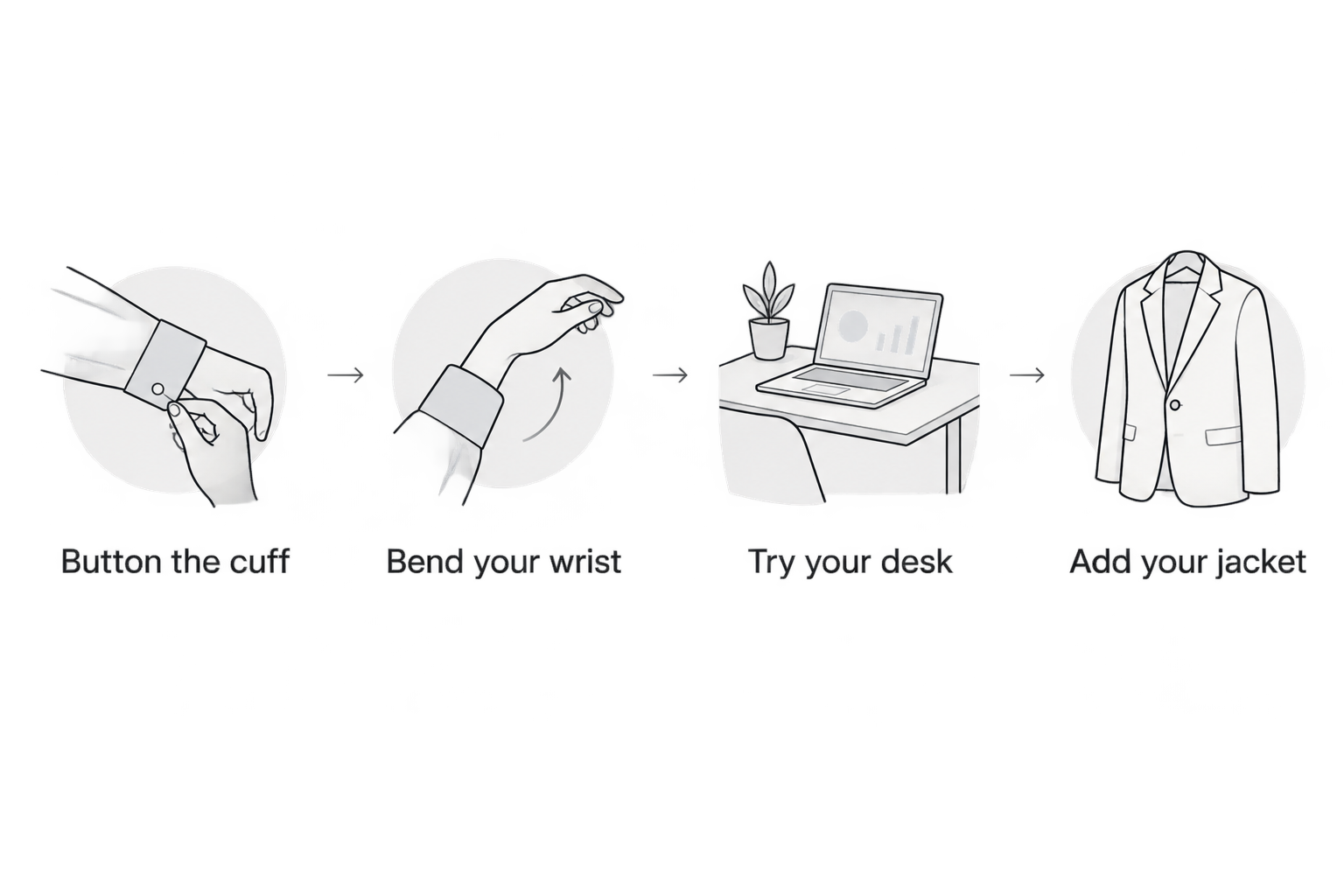
- Button the cuff. Fasten the shirt normally without pulling fabric over the bracelet by force. If the cuff only closes when you compress everything underneath, choose a different pairing.
- Bend your wrist. Reach forward, turn your palm upward, and bring your hand toward your shoulder. Look for pressure, catching, or fabric trapped around the bracelet.
- Try your desk. Rest your forearm where you type or write. Notice whether the bracelet presses against your wrist or repeatedly hits the work surface.
- Add your jacket. Slide the sleeve on and off slowly. Check that the bracelet does not drag the shirt cuff backward.
A bracelet does not have to remain completely hidden to fit well. The useful distinction is between an occasional glimpse as you move and a sleeve that stays stuck above the jewelry.
Link bracelets: best for movement beneath a sleeve
A link bracelet is a useful starting point when you prefer your jewelry to appear as your arm moves. Its connected sections move around the wrist instead of holding a single rigid shape.
That does not make every chain suitable for every shirt. Large links, a prominent clasp, or an overly loose fit still need space, so inspect the whole bracelet rather than judging only the front-facing design.
For a restrained outfit, wear the link bracelet alone beneath a buttoned cuff. With an open collar and relaxed trousers, let a little more of the bracelet show without adding another wrist accessory.
Choose links when movement matters more than a fixed silhouette. Pass on a particular design if its clasp or proportions keep interfering with the shirts you actually wear.
Cuff bracelets: best for a visible statement
A sculptural cuff makes more sense when you want the bracelet to be part of the outfit's outline. An open shirt cuff or neatly rolled sleeve gives its shape room to show.
Do not assume an open-ended bracelet is designed for repeated bending. Check the individual product's adjustment instructions before changing its shape, and never force the opening to solve a shirt-fit problem.
Try a structured white shirt, straight-leg trousers, and a cuff as the main jewelry statement. Keep the wrist free of a watch if the combination feels crowded.
Choose a cuff when you want visible shape, not just a flash of metal. A raised or wide design is a less practical choice for a narrow buttoned sleeve, regardless of how good it looks on its own.
Two-tone bracelets: best for mixing your metals
You do not have to choose between gold-tone and silver-tone accessories. A two-tone bracelet gives you both finishes in one place, which makes a mixed-metal outfit easier to build deliberately.
Start with the accessories you already own. If your watch is silver-tone and your favorite ring is gold-tone, a bracelet containing both colors can repeat that combination without requiring matching pieces everywhere.
For a 2026 wardrobe refresh, try changing the metal mix before replacing your shirts. A familiar blue button-down takes on a different mood when you swap a single-tone bracelet for a contrasting design.
The trade-off is visual activity. If your shirt already has a strong pattern, keep the bracelet silhouette simpler rather than adding several competing textures.
Why the right bracelet-and-shirt pairing varies
There is no universal bracelet width that works beneath every dress shirt. These details determine whether your chosen pairing feels easy or fussy:
- Cuff room: A close-fitting shirt cuff leaves less space for a bracelet than a roomier one. Check the sleeve fastened, not just laid flat.
- Bracelet shape: Links move around the wrist; a rigid cuff keeps its form. Judge each against your normal hand movements.
- Surface details: Raised flowers, textured edges, and prominent settings need their own clearance check. Look for fabric catching as you move.
- Other accessories: A watch or second bracelet adds another object beneath the sleeve. Try the full combination together.
- Your routine: Desk work, frequent jacket changes, and hands-on tasks call for different practical choices. Remove jewelry when workplace rules or task safety require it.
Buy for the combination, not the category name. “Stainless steel” identifies a material; it does not tell you whether a particular bracelet fits beneath your shirt.
Which bracelet designs make sense for this look?
GRISÉ NYC stainless steel bracelets are best for shoppers who want statement shapes and mixed-metal styling. For this shirt pairing, the useful distinction is between a moving link design and a sculptural cuff—not a claim that either fits every wrist.
These options use stainless steel with 18k gold-plated details. Gold plating is not solid gold, and neither description establishes identical care requirements across the collection.
| Product | Best for | Description-backed detail | Styling trade-off |
|---|---|---|---|
| 2-Tone Link Bracelet | Repeating gold-tone and silver-tone accessories | Alternating stainless steel and 18k gold-plated links, including 9 mm gold links | Check the actual fit and clasp clearance beneath a buttoned cuff |
| 2-Tone Smooth Twist Cuff Bracelet | Giving an open sleeve a focal point | A smooth band set against a twisted band, with stainless steel and 18k gold-plated accents | The sculptural silhouette needs a separate cuff-clearance check |
The 2-Tone Link Bracelet is the option to consider when you prefer the look of connected links. Pair it with a plain shirt first so you can judge the alternating finishes without a busy print competing for attention.
The 2-Tone Smooth Twist Cuff Bracelet suits an outfit built around contrasting surfaces. Give the smooth-and-twisted design some visible space rather than buying it specifically to hide beneath a tight sleeve.


Should you wear a bracelet on the same wrist as your watch?
Wear the bracelet on the opposite wrist when you want to reduce contact between the accessories. That also lets you check each sleeve separately instead of fitting both pieces beneath the same cuff.
A shared wrist is a styling choice, not a requirement. If you prefer it, move your arm through your normal routine and listen for repeated contact; separate the pieces if the combination feels distracting.
For a first bracelet-and-shirt outfit, keep the watch and bracelet apart. You can experiment with stacking once you know how each piece behaves on its own.
Should the bracelet sit over or under the shirt cuff?
Wear the bracelet beneath the shirt cuff for a discreet look, or expose it with an intentionally open or rolled sleeve. Avoid leaving the fabric halfway caught on the bracelet.
For a bolder 2026 outfit, try a sculptural cuff beside a neatly rolled sleeve rather than forcing jewelry over the shirt. This lets you see the design without asking the bracelet to fit around both your wrist and folded fabric.
Check the finished outfit with your arm relaxed. A sleeve arranged perfectly in a mirror still needs to work when your hand drops to your side.
Can you wear it with a suit or to a formal event?
Wear a stainless steel bracelet with a suit when the event's dress requirements allow jewelry and the bracelet fits beneath both sleeves. Start with a single piece and leave room for the shirt cuff to move.
A formal dress code is not the place to treat styling advice as permission. Follow the invitation or workplace requirements, and leave the bracelet off when the expected outfit calls for less decoration.
Keep the shirt crisp and the jewelry cared for
Before dressing, check the bracelet for residue and inspect the surfaces that touch your sleeve. Follow its specific cleaning instructions rather than treating every stainless steel, plated, pearl, and stone-accented piece alike.
Use product-specific guidance for water exposure, cleaning products, and storage. The presence of stainless steel does not establish how every added finish or decorative detail should be treated.
For 2026 shopping, make the care description part of your decision—not something you read after purchase. If a bracelet's requirements do not suit your routine, choose a different piece instead of assuming everyday styling means unrestricted wear.
FAQ
Can I wear a stainless steel bracelet with a dress shirt at work?
Yes, you can wear a stainless steel bracelet with a dress shirt at work when your workplace rules allow it. Choose a fit that lets the cuff close and does not interfere with your tasks.
What's the best bracelet style for a buttoned shirt cuff?
A close-fitting link bracelet is a useful starting point for a buttoned shirt cuff. Check the clasp and full bracelet profile, because connected links alone do not guarantee clearance.
Can I mix a gold-tone bracelet with a silver-tone watch?
Yes, you can mix a gold-tone bracelet with a silver-tone watch. A two-tone bracelet repeats both finishes, while wearing the pieces on opposite wrists reduces contact.
Should my bracelet show when my shirt sleeve is down?
Your bracelet does not need to stay visible when your shirt sleeve is down. An occasional glimpse as you move is enough; the sleeve should not remain caught above it.
Are GRISÉ NYC gold-plated bracelets solid gold?
No, GRISÉ NYC pieces described as 18k gold-plated are not solid gold. Check each bracelet's description for its base material, decorative details, and care instructions.
Can I wear a chunky cuff with a dress shirt?
Yes, you can wear a chunky cuff with a dress shirt if you give the bracelet enough space. An open cuff or rolled sleeve is a practical styling option when a buttoned sleeve catches.
Should I take my bracelet off while typing?
Take your bracelet off while typing if it presses against your wrist or repeatedly hits the desk. Test your normal working position before choosing it for an office outfit.
One last thing
Shop your shirt drawer before you shop for another bracelet. Try your existing jewelry with a fitted cuff, an open cuff, and a rolled sleeve; the sleeve position can change which piece feels right.
When you do add a GRISÉ NYC bracelet, choose the design that works with your real routine. Bold jewelry earns its place when you enjoy wearing it—not when you spend the day rearranging your sleeve.


