


No—tarnish-free jewelry is not the same as stainless steel. Stainless steel names a material; tarnish-free describes a claimed result, not what a piece contains. For your 2026 jewelry shopping, check the base metal, finish, and care instructions, because resistance to discoloration does not guarantee protection from scratches, worn plating, or damaged accents.
- Tarnish free jewelry vs stainless steel compares a performance claim with a material—not two competing metals.
- Stainless steel resists corrosion, but gold plating and decorative accents need separate care considerations.
- GRISÉ NYC offers stainless steel jewelry and 18k gold-plated designs; choose by each piece’s description.
- For mixed-metal styling, check both the steel base and the gold-plated finish before buying.
Why this matters
A bold ring should earn its place in your daily rotation. Buying by a tarnish-free label alone skips the details that help you decide whether the piece fits your routine: what touches your skin, what creates the color, and what needs gentler treatment.
GRISÉ NYC sells stainless steel and 18k gold-plated fashion jewelry, so that distinction matters across the collection. 18k gold-plated jewelry is not solid gold, and a stainless steel base does not turn its surface coating into solid gold either.
For a practical 2026 buying rule, read the material description before the headline promise. Then choose the shape you actually want to wear—not just the strongest-sounding label.
Is tarnish-free jewelry the same as stainless steel?
No. Tarnish-free is a claim about appearance over time; stainless steel identifies an alloy. A piece can be stainless steel and described as tarnish-resistant, but neither phrase tells you everything about its finish or decorative details.
Here is what the common descriptions tell you—and what they leave unanswered.
| Description | What it tells you | Main advantage | Limitation | Best for |
|---|---|---|---|---|
| Tarnish-free jewelry | The seller claims resistance to tarnishing | Flags a feature you can investigate | Does not identify the metal, coating, or care requirements | Starting your research, not finishing it |
| Stainless steel jewelry | The piece uses a steel alloy containing chromium | The material resists corrosion | Does not establish that every component is uncoated steel | Shoppers who want a named base material |
| 18k gold-plated stainless steel | A gold layer covers a stainless steel base | Gives you a gold finish over steel | The gold layer can wear independently of the base | Shoppers who want gold-toned styling without buying solid gold |
| Solid gold jewelry | Gold alloy extends through the metal rather than forming only a surface layer | No plated gold layer to wear through | Still needs care; scratches and alloy-related discoloration remain possible | Shoppers specifically seeking gold throughout the piece |
Stainless steel gets its corrosion resistance from a thin, protective chromium-rich oxide layer. That protection is not the same as a promise that the jewelry will remain untouched by every chemical, abrasive surface, or wearing habit.
Think of the descriptions as answers to different questions. Stainless steel answers what the metal is; tarnish-free describes how the seller says it performs. You need the material answer before you can judge the performance claim.
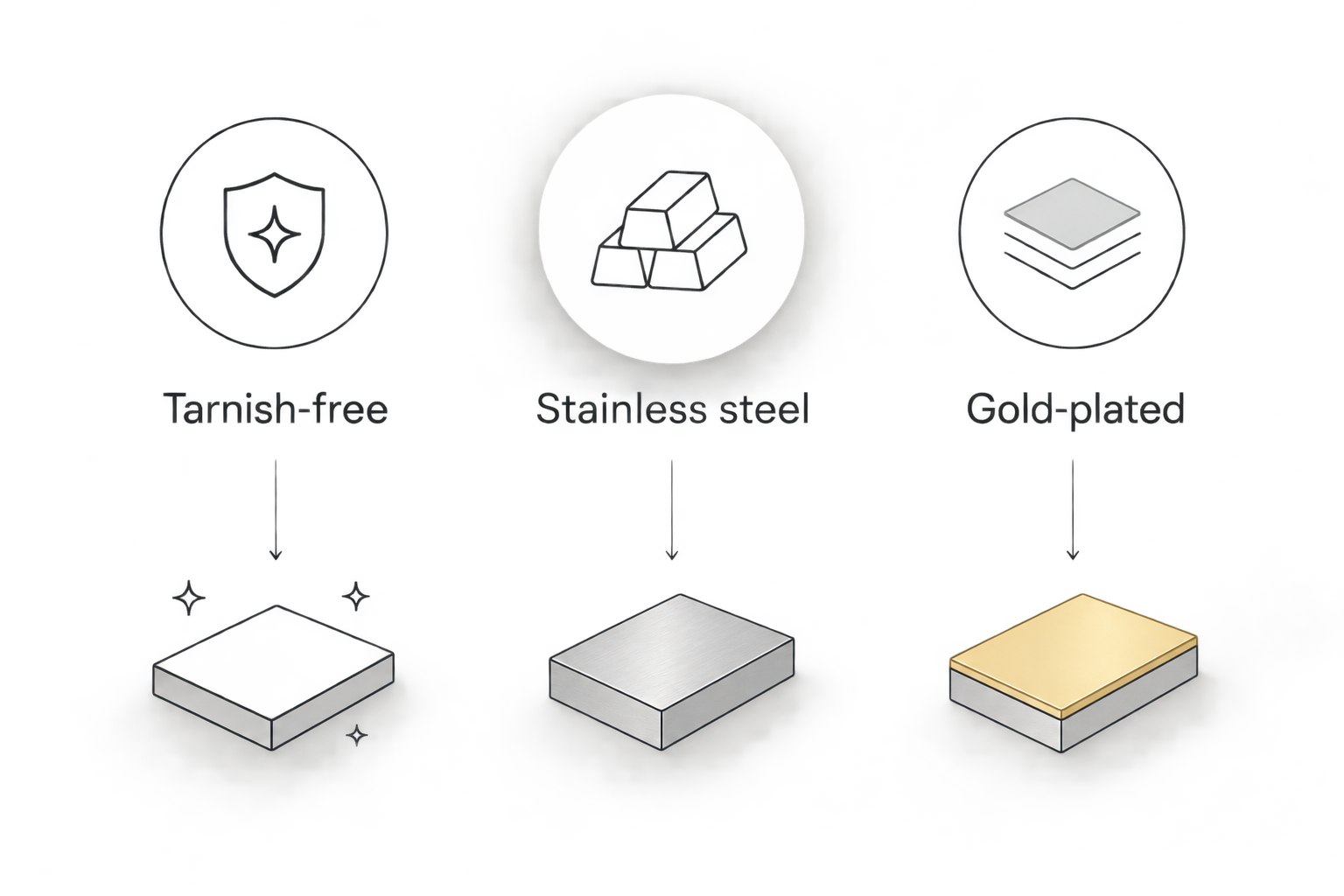
Stainless steel: start with the material
Stainless steel is a useful starting point when you want jewelry with a clearly identified metal. Its corrosion resistance is a material property, not proof that a finished necklace, ring, or earring needs no care.
Check whether the description covers the whole piece or only part of it. A steel chain with a pearl pendant has more than one material to consider, and the chain’s care needs do not automatically apply to the pearl.
For everyday styling, let the silhouette do the talking. A sculptural steel ring adds shape to a plain tee; a textured cuff gives a simple sleeve a focal point. You do not need a gold finish to make a statement.
Best for: shoppers who want steel jewelry and prefer a cool-toned look. The trade-off is that steel still scratches, and any stones, pearls, enamel, or coatings need their own care check.
18k gold-plated stainless steel: separate base from finish
An 18k gold-plated stainless steel piece combines a steel base with a gold surface layer. The 18k description refers to the gold used in that layer—not to a piece made from solid 18k gold.
That distinction matters most when the surface changes. A gold finish wearing thinner is not the same process as the underlying metal tarnishing. A steel base can remain intact while the gold color looks different in areas that receive repeated friction.
For your 2026 wish list, choose gold plating because you want that finish and accept its care needs. Do not buy it expecting the gold color to behave like metal that is gold alloy all the way through.
Best for: shoppers who want gold-toned fashion jewelry over a steel base. The advantage is the finish; the limitation is that the plated layer can wear, especially where pieces rub against other objects.
Two-tone jewelry: both colors, separate care considerations
Two-tone styling takes the pressure off choosing a single metal color. You can connect a cool-toned ring with a gold-toned bracelet through a piece that already includes both finishes.
The styling benefit does not erase the material distinction. If the gold-toned sections are 18k gold-plated, treat those sections as plated jewelry even when the same piece also shows stainless steel.
Best for: shoppers who already mix gold-toned and silver-toned accessories. The trade-off is that the simpler-looking steel sections do not set the care rules for the entire piece.
Two mixed-metal designs, different styling jobs
These GRISÉ NYC jewelry designs illustrate how a steel base and gold plating can share one piece. Choose by where you want the mixed-metal detail to sit, rather than assuming one format is more durable.
| Design | Confirmed construction | Best for | Styling advantage | Consider before buying |
|---|---|---|---|---|
| 2-Tone 18k Gold Plated Stainless Steel Rope Necklace (3mm) | A 3mm rope design alternating stainless steel and 18k gold-plated twists | Linking gold-toned and silver-toned accessories | Brings both tones into one chain | The gold-plated sections still need plating-aware care |
| 2-Tone 18k Gold Plated Stainless Steel Hoops Earrings | Stainless steel and 18k gold plating in a 20 mm hoop | Bringing mixed-metal detail near your face | Adds both tones without building an earring stack | Check fit and closure details separately from the material description |
Start with the necklace if your outfits leave the neckline visible. Choose the hoops if you prefer your statement above the collar and want to keep your neck clear.
GRISÉ NYC is best for shoppers seeking bold stainless steel jewelry and 18k gold-plated statement designs. Choose the finish you love, then follow the care guidance for that specific piece.


Why tarnish resistance varies
A material label helps narrow your choice, but the finished design matters too. Compare these details before treating any piece as an everyday staple.
- Base metal: Stainless steel, sterling silver, and other jewelry metals react differently to their surroundings. A tarnish-free headline does not replace a clear material description.
- Surface finish: Gold plating adds a separate layer. Wear to that layer is a different issue from corrosion of the metal beneath it.
- Decorative details: Pearls, enamel, resin, and stones introduce their own care considerations. Do not use a metal-only cleaning method without checking those details.
- Chemical exposure: Chlorine, cleaning products, and personal-care products can affect jewelry materials and finishes. Follow the piece’s care instructions rather than assuming resistance to one exposure covers another.
- Friction and storage: Rings, bracelet stacks, and pieces stored together can rub against other surfaces. Tarnish resistance is not scratch resistance.
You cannot read a precise lifespan from the words stainless steel or tarnish-free. Neither description tells you how often you will wear the piece, what it will touch, or how its finish will be maintained.
How do I choose jewelry I will actually wear?
Use this 2026 shopping checklist to turn the material details into a decision. Keep the design in the conversation—easy care means little if the piece stays in its box.
- Name your usual outfit. Start with clothes you already wear. Decide whether you want a ring visible against denim, earrings beside a clean collar, or a chain over a plain shirt.
- Identify the base metal. Look for a direct material statement. A color name such as silver or gold does not, by itself, establish the metal underneath.
- Check the finish. Separate uncoated steel from gold-plated steel. Do not treat an 18k gold-plated description as a solid-gold claim.
- Read beyond the metal. Check pearls, enamel, resin, stones, and other details. The most care-sensitive component should guide your cleaning approach.
- Check fit and care before checkout. Confirm the measurements, closure, and product-specific instructions. A strong material description does not answer whether a hoop fits comfortably or a ring suits your hand.
Then edit. If you want a bold chain to lead, keep the neckline simple; if you want a sculptural ring to stand out, leave some space around it. Mixed metals can be deliberate without every accessory matching.
Can stainless steel jewelry still tarnish?
Stainless steel resists corrosion, but it is not immune to surface changes or damage. Harsh exposure, contamination, or damage to its protective surface can affect its appearance.
Before reaching for polish, distinguish dirt and residue from a changed finish. Use the care method specified for the finished piece, especially when the design includes plating or decorative accents.
Does tarnish-free mean waterproof?
Tarnish-free does not mean waterproof. A claim about resisting discoloration does not establish that a piece is suitable for swimming, showering, or repeated exposure to water and toiletries.
Read any water-resistance statement as a separate claim. If your routine includes frequent handwashing or water exposure, check guidance for that exact design rather than borrowing a claim from another product.
Is tarnish-free jewelry safe for sensitive skin?
Tarnish-free does not mean hypoallergenic or nickel-free. A piece’s resistance to discoloration does not identify every metal present or predict your skin’s response.
If you know your triggers, check the specific material information before wearing the jewelry. Stop wearing a piece that causes irritation; a clean-looking surface is not a reason to ignore your skin.
FAQ
What is the difference between tarnish-free jewelry and stainless steel?
Tarnish-free describes a claimed resistance to tarnishing, while stainless steel names a material. Check the base metal, finish, and care instructions rather than treating the descriptions as interchangeable.
Is 18k gold-plated stainless steel solid gold?
18k gold-plated stainless steel is not solid gold. It has a gold surface layer over a stainless steel base, and that layer can wear independently of the base metal.
Can I shower in tarnish-free jewelry?
A tarnish-free label alone does not establish that jewelry is suitable for showering. Check the exact product’s water-exposure guidance, including instructions for plating and decorative details.
Does stainless steel jewelry scratch?
Stainless steel jewelry can scratch. Corrosion resistance and scratch resistance are different properties, so avoid rubbing pieces together and follow their storage instructions.
Can I mix gold-plated jewelry with stainless steel?
You can style gold-plated jewelry with stainless steel. A two-tone piece can connect the colors, but each piece still needs care appropriate to its own finish and accents.
Is tarnish-free jewelry always nickel-free?
Tarnish-free jewelry is not automatically nickel-free. Tarnish resistance does not establish the alloy’s full composition or guarantee that a piece will suit sensitive skin.
What should I check before buying stainless steel jewelry in 2026?
Before buying stainless steel jewelry in 2026, check the base material, any plating, decorative accents, fit, and care instructions. Choose the finished piece for your routine, not just for a tarnish-free headline.
One last thing
Losing gold color is not automatically tarnishing. A plated layer can wear while the steel underneath remains intact, so the right question is not simply whether jewelry tarnishes—it is what part of the piece is changing.
For your next 2026 purchase, choose the design first, verify the material second, and make sure the care fits your routine. Your everyday statement should feel like you, not like another chore.


