


A gold-plated necklace can turn your neck green, but it does not happen with every piece or every wearer. The green mark usually comes from copper-containing metal reacting with moisture and transferring residue to your skin, especially where plating has worn. Green staining alone is not the same as an allergic reaction; itching, redness, or a rash calls for a different response.
- Will a gold plated necklace turn neck green? Sometimes; exposed copper-containing metal is a common cause.
- 18k gold plating describes the surface, not the metal underneath or a guarantee against skin staining.
- Wash green residue gently; stop wearing the necklace if your skin becomes itchy, red, or sore.
- GRISÉ NYC jewelry buyers should check each necklace’s materials and care instructions rather than assume matching performance.
Why this matters
A necklace should finish your outfit, not leave you troubleshooting your neckline. Before you rule out every gold-colored chain, separate the finish, the underlying metal, and what is happening on your skin.
When browsing GRISÉ NYC jewelry in 2026, read the individual description rather than treating every gold-tone piece as the same material. A color tells you how a necklace looks. It does not tell you its full construction, its care needs, or how your skin will respond.
Will a gold-plated necklace turn your neck green?
Yes, a gold-plated necklace can leave a green mark when copper-containing metal reacts and the resulting residue transfers to your skin. An intact gold layer separates your skin from the metal underneath, but plating wears with use. Exposed areas, chain connections, or other components can become contact points.
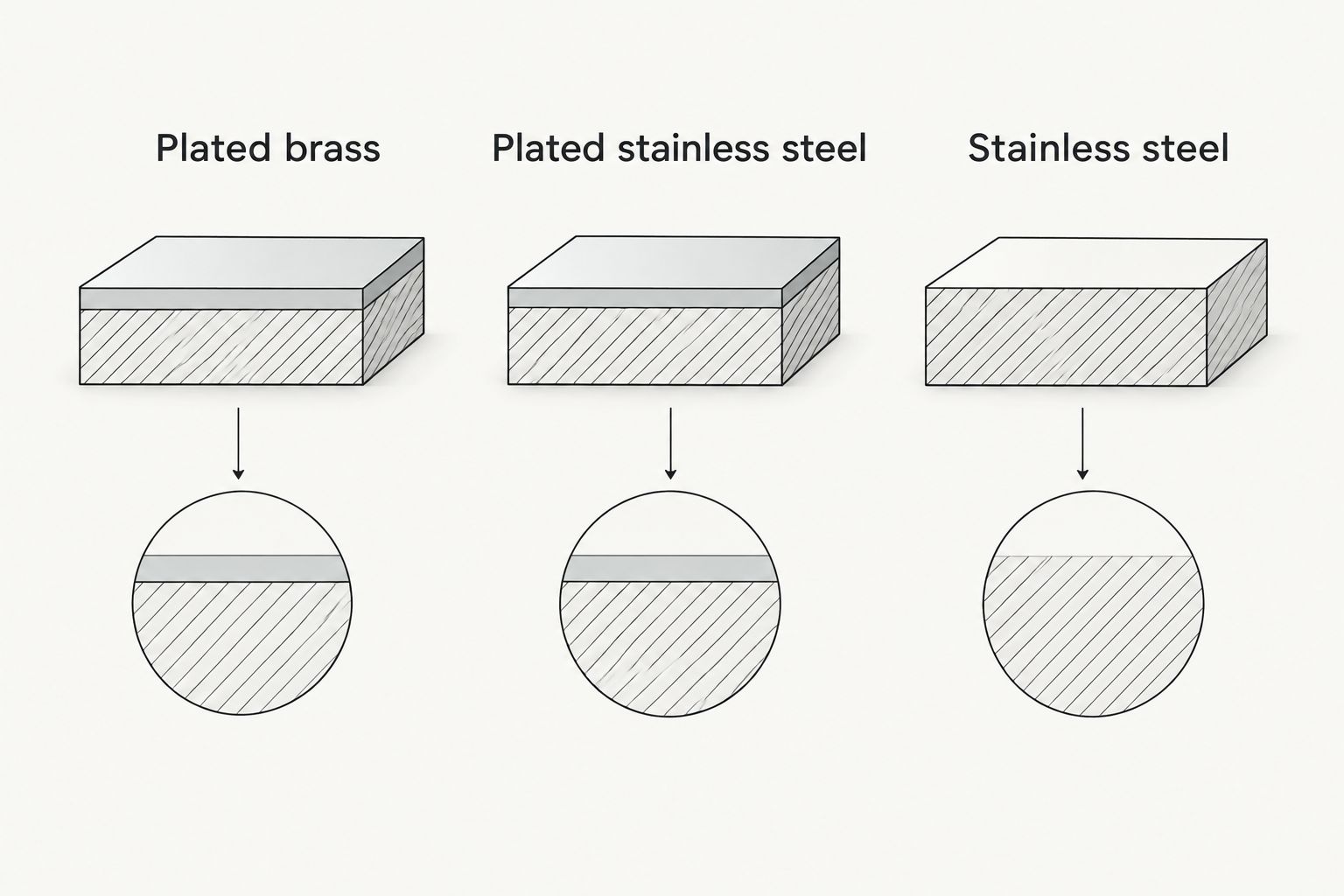
The base metal matters. Brass contains copper; stainless steel has a different composition and resists corrosion, but neither a material name nor a gold-colored finish guarantees a reaction-free experience.
| Construction | Best for | Main advantage | Main limitation |
|---|---|---|---|
| Plated brass | A gold finish when you accept ongoing care | Gives you a gold surface over a shaped base metal | Exposed copper-containing brass can contribute to green staining |
| Plated stainless steel | A gold finish over a corrosion-resistant base | Combines a gold surface with a stainless steel foundation | The plating still wears; stainless steel is not an allergy guarantee |
| Stainless steel | A silver-tone look without gold plating | Avoids maintaining a gold-plated surface | Does not give you the same warm gold finish; individual sensitivities still matter |
These are material comparisons, not promises about every necklace in a category. Pendants, clasps, chains, and decorative details do not necessarily share the same construction.
Does 18k gold plating prevent a green neck?
No. The 18k label describes the gold alloy used for the plated layer, not a promise that the necklace cannot stain your skin. In standard karat terms, 18k means 18 parts gold out of 24 parts metal, equivalent to 75% gold in that alloy.
That does not mean a gold-plated necklace is 75% gold overall. The gold alloy forms a surface layer over another material. Solid gold and gold-plated jewelry are different constructions.
For your 2026 jewelry shortlist, ask what sits underneath the finish. “18k gold-plated stainless steel” gives you more useful information than a description that only says “gold.” Neither phrase tells you the plating thickness unless that detail is separately stated.
Buy for the complete material description, not the biggest gold number. A clear base-metal description helps you compare pieces without mistaking a finish for the entire necklace.
Why green staining varies
The same necklace does not meet the same conditions on every neck. These factors help explain the difference:
- Base metal. Copper-containing metals can produce green compounds that transfer to skin. The metal underneath the gold layer matters when it becomes exposed.
- Plating condition. Worn areas reduce the separation between your skin and the base metal. Inspect contact points rather than judging only the front of the pendant.
- Moisture and sweat. Damp conditions help metal reactions occur and move residue onto your skin. Sweat also contains salts.
- Skin products. Lotion, sunscreen, and fragrance can leave residue where the chain sits. Product ingredients and buildup affect the necklace’s contact environment.
- Friction and contact. Repeated rubbing contributes to surface wear. A necklace moving against your neck meets different conditions from one stored between occasional outings.
These factors do not create a reliable countdown. There is no universal number of wears before a gold-plated necklace leaves a mark, and an unstained neck does not prove the plating will last indefinitely.
What should you do if your neck turns green?
Start with your skin, then the necklace. Do not keep wearing the piece while scrubbing harder at the mark.
- Remove the necklace. Give your skin a break and check whether you have a flat stain or irritation such as itching, redness, or soreness.
- Wash gently. Use mild soap and water on the stained skin, then rinse and pat dry. Avoid harsh cleaners, abrasive scrubs, and jewelry-cleaning chemicals on your neck.
- Inspect the piece. Look for worn patches, discoloration, buildup, or a finish that looks different around the clasp and contact areas. Inspection helps identify wear; it does not establish the exact metal composition.
- Follow the necklace’s care directions. Use only cleaning methods appropriate to its materials. Pearls, glued components, stones, and plated surfaces do not all tolerate the same treatment.
- Reassess before wearing it again. If staining returns, stop wearing that necklace against your skin and choose a different construction. Seek medical advice for persistent irritation or an ongoing rash.
For a simple 2026 care routine, keep skin cleaning separate from jewelry cleaning. Something suitable for removing a skin mark is not automatically suitable for restoring a plated pendant.
Is a green mark an allergy?
A green mark alone does not establish a metal allergy. Color transfer and allergic contact dermatitis are different things, although staining and irritation can happen together.
Pay attention to how your skin feels, not just the color you see. Itching, redness, swelling, or a rash is a reason to remove the necklace, even if there is no green residue. Do not wear a piece through discomfort to see whether your skin gets used to it.
Stainless steel is not a universal answer for sensitive skin because some stainless steel contains nickel. If you already know you react to nickel or another metal, check the specific composition and discuss suitable jewelry with a dermatologist. A silver-tone appearance does not establish nickel content.
How do you choose a necklace you will actually wear?
Pick the look first, then check whether its materials suit your routine. You do not need to give up bold jewelry; you need to avoid buying a care commitment you already know you will ignore.
For GRISÉ NYC necklaces, compare product-specific construction rather than extending one piece’s description across the collection. These examples show the distinction between a plated statement pendant and a stainless steel design.
| Necklace | Best for | Confirmed construction or detail | Trade-off |
|---|---|---|---|
| Rugged Cross Pendant Gemstone Necklace | A warm gold statement with a hammered finish | Gemstone accents in a hammered-texture cross of 18k gold-plated stainless steel | Gold plating needs finish-appropriate care; the description does not guarantee zero skin staining |
| Iced Teddy Bear Pendant Rope Chain Necklace | A playful silver-tone statement | Cubic zirconia in a stainless steel teddy bear on a 3mm rope chain | It does not provide a gold finish, and stainless steel is not a guarantee against individual sensitivity |
GRISÉ NYC necklaces are best for shoppers who want distinctive statement designs and choose materials piece by piece. Neither example establishes how every necklace will behave on every wearer.


Make mixed metals work for you
If you like warm gold but prefer wearing a particular stainless steel chain against your neck, let your other accessories supply the contrast. Try that silver-tone chain with gold-tone earrings or a ring you already own. Matching every metal is a styling choice, not a requirement.
Keep the necklace as the focal point when the pendant is bold. A plain tee or open shirt gives its shape room to show without requiring a stack of additional chains. If you do layer, check where the pieces rub against each other instead of assuming extra shine comes without extra friction.
Your 2026 buying checklist
Before you commit, check these details:
- The base metal: Look for a named material, not just a color.
- The finish: Separate gold-plated, gold-tone, and solid gold descriptions.
- The components: Check whether the description covers the chain as well as the pendant.
- The care instructions: Match them to how you genuinely plan to wear the necklace.
- Your skin history: Treat a known metal sensitivity as a buying criterion, not an afterthought.
A confident purchase is not the necklace with the loudest durability wording. It is the one whose actual description answers your questions.
How can you reduce green marks without changing your style?
Give the necklace a cleaner, drier wearing environment. Let skincare products dry before putting it on, and follow its instructions about water, exercise, and cleaning. After wear, remove residue using the recommended method and store the piece dry.
Do not turn a general care tip into a waterproof claim. A stainless steel base, an 18k finish, or a bold design does not establish that every component tolerates swimming, showering, or cleaning chemicals.
Avoid DIY fixes that create another problem. Clear nail polish adds a coating that chips and introduces its own ingredients; it does not repair missing gold plating. Harsh polishing can also remove more of a plated surface instead of restoring it.
FAQ
Will a gold-plated necklace always turn my neck green?
No, a gold-plated necklace does not always turn your neck green. Base metal, plating condition, moisture, and skin products affect whether residue transfers to your skin.
Does 18k gold-plated mean the necklace is solid gold?
No, 18k gold-plated means the piece has a surface layer of an 18k gold alloy over another material. It does not mean the whole necklace is solid gold or 75% gold overall.
Is a green neck from jewelry dangerous?
A green stain alone does not establish an allergy or a medical problem. Remove the necklace, wash gently, and seek medical advice if you also have persistent itching, redness, swelling, or a rash.
How do I get green necklace marks off my skin?
Wash the stained skin gently with mild soap and water, then rinse and pat dry. Avoid abrasive scrubs and never put jewelry-cleaning chemicals on your skin.
Is stainless steel better than plated brass for avoiding green marks?
Stainless steel avoids the copper-containing brass base that commonly contributes to green staining when exposed. It is not a guarantee against all discoloration or skin reactions, and some stainless steel contains nickel.
Can I shower in any gold-plated necklace?
No, gold plating alone does not establish shower suitability. Follow the individual necklace’s care instructions, including instructions for its stones, pearls, and other components.
Will clear nail polish stop a necklace from turning my neck green?
Clear nail polish is not a reliable repair for worn plating. It can chip, introduces additional ingredients against your skin, and does not replace the original gold finish.
One last thing
For your next 2026 purchase, inspect the least glamorous part of the necklace: the clasp and the chain near it. Those details deserve the same material questions as the pendant you fell for.
A meaningful symbol or a bold statement still needs a material description that works for you. Choose both, and you are shopping for a necklace you will wear—not just one you like in a photo.


