


Table of Contents
- Why Stainless Steel Necklaces Outlast Plated Jewelry
- Quick Comparison: Top Stainless Steel Necklaces for 2026
- 316L Stainless Steel Necklace: The Grade That Protects Sensitive Skin
- How to Spot a High-Quality Stainless Steel Chain Necklace
- Stainless Steel Pendant Necklace: Choosing a Statement Centerpiece
- Stainless Steel Necklace Care: Low-Maintenance Rules That Work
- Styling and Layering: Building a Cohesive Stack
- Conclusion: Choosing Your Everyday Stainless Steel Necklace
- Frequently Asked Questions
Last Updated: October 9, 2026
Why Stainless Steel Necklaces Outlast Plated Jewelry
If you have watched a gold-plated chain turn green or flake apart within months, you know the problem: the gold layer sits on a cheaper base metal, and once it wears through, the piece is done. When you buy high quality stainless steel necklaces, you are buying solid metal instead of a coating, which is why it holds up where plating fails.

At GRISÉ NYC, we build our stainless steel necklaces for exactly this reason: everyday wear without the fading, irritation, or replacement cycle of plated pieces.
Stainless steel is an alloy of iron, chromium, and often nickel and molybdenum. The chromium forms a protective surface layer that resists rust and corrosion and regenerates, so the metal does not pit or discolor the way plated brass does, a necklace you can keep on through workouts, showers, and long days.
Quick Comparison: Top Stainless Steel Necklaces for 2026
Here is a side-by-side look at our most popular stainless steel necklaces, so you can match the piece to how you wear jewelry.
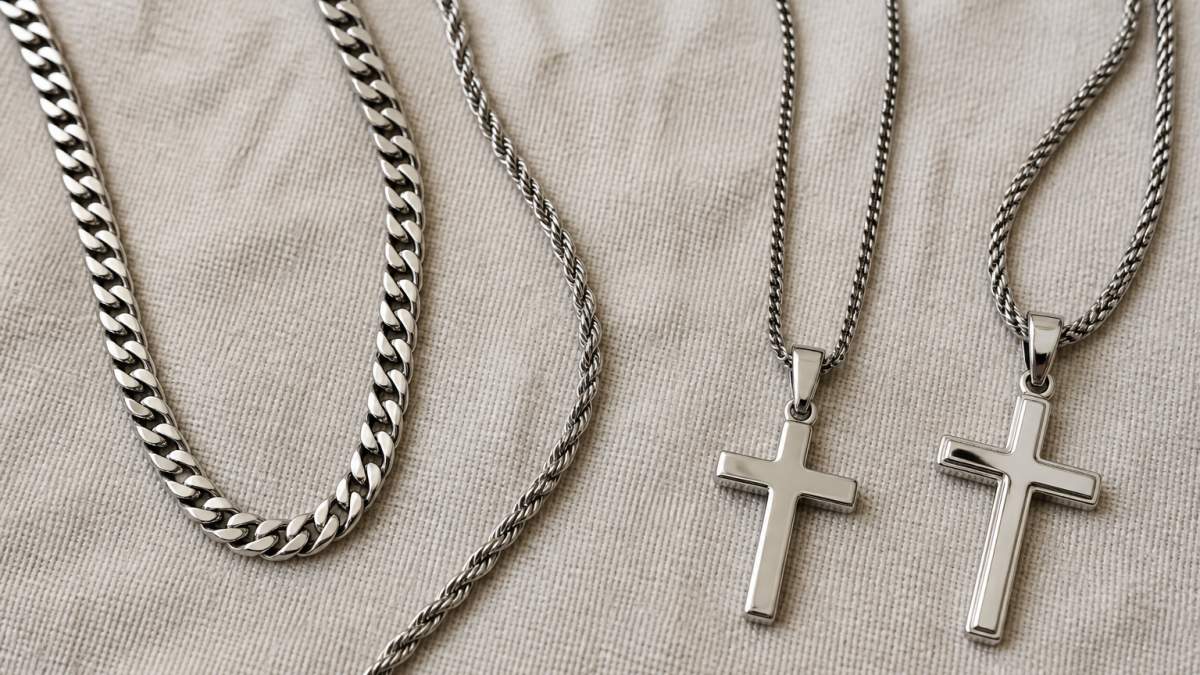
| Necklace | Price | Chain Style | Best For |
|---|---|---|---|
| Cuban Link Stainless Steel Necklace | $68.00 | Cuban link, 8mm | Bold standalone statement |
| Twisted Snake Stainless Steel Necklace | $68.00 | Twisted snake | Layering and everyday wear |
| The Sovereign Necklace - Silver | $62.00 | Chunky curb link | Sharp, structured stacks |
| 'I Am Woman' Steel Necklace | $64.00 | Twisted rope | Meaningful statement pieces |
| Nugget Cross Pendant Necklace | $54.00 | Nugget cross pendant | Minimal, adjustable wear |
| Eterna Cross Pendant Necklace | $60.00 | Polished cross with stones | Refined everyday elegance |
| Steel Baroque Cross Pendant Necklace | $62.00 | Filigree cross, cat's eye stone | Vintage-inspired focal pieces |
| Cowboy Boot Pendant Steel Necklace | $68.00 | Boot pendant, CZ stones | Playful, Western styling |
| Multi Freshwater Pearl Steel Bead Necklace | $68.00 | Pearl and steel beads | Soft layering contrast |
Every piece uses stainless steel construction, so the choice comes down to style, not durability.

316L Stainless Steel Necklace: The Grade That Protects Sensitive Skin
A 316L stainless steel necklace is the grade most often recommended for sensitive skin. The "L" stands for low carbon, which prevents chromium carbide from forming during welding and forming.
316L also adds molybdenum, typically 2 to 3 percent, giving it an edge over 304 in chloride-rich environments, sweat, salt water, and chlorinated pools. That is why 316L is used in surgical implants, food processing equipment, and marine hardware.
How the grades you will see on a product page compare:
- 304 stainless steel: Roughly 18 percent chromium and 8 percent nickel, no molybdenum. Durable and affordable, but it releases more nickel over time than 316L, so it is most likely to bother someone with a genuine nickel allergy.
- 316L stainless steel: Roughly 16 to 18 percent chromium, 10 to 14 percent nickel, plus molybdenum. Lower carbon and higher corrosion resistance, the standard for jewelry worn daily against the skin, and what most sellers mean by "surgical grade."
- 430 stainless steel: A ferritic grade with chromium but little to no nickel. Magnetic and cheaper, often used in budget chains and findings. It resists rust reasonably well but is not for daily wear against sensitive skin.
How to Verify a Nickel-Free Claim Before You Buy
"Hypoallergenic" is not a regulated term in the United States, so any seller can print it on a label. If you have a real nickel allergy, you need more than a marketing word. Practical checks:
- Look for the grade, not the adjective. "316L" or "surgical grade stainless steel" is a specific claim a seller can be held to. "Hypoallergenic stainless steel" is not.
- Check for a nickel-release or compliance statement. The EU Nickel Directive (EN 1811) sets a release limit of 0.5 micrograms per square centimeter per week for items in prolonged skin contact. In the U.S., there is no equivalent federal standard, so third-party lab reports (often from SGS, Intertek, or Bureau Veritas) are the closest to independent proof.
- Ask about the clasp and findings. Even a 316L chain can have a plated or 304 clasp. The clasp sits against your skin at the back of the neck, so it is often the part that triggers a reaction.
"Stainless steel" on its own tells you almost nothing. Without a grade, you cannot know whether you are getting 316L, 304, or a 430 chain with a plated clasp. Ask before you buy.
For daily wear against sensitive skin, 316L is the grade to look for. For occasional wear or a budget piece, 304 is a reasonable compromise. If a seller will not name the grade, assume the lowest one.
How to Spot a High-Quality Stainless Steel Chain Necklace
Quality in a stainless steel chain necklace comes down to three things: the grade of steel, the finish, and the hardware. A high-polished finish reflects light evenly with no cloudy patches; a matte finish should look intentional, not unfinished.
Check these markers before you buy:
- Grade stated clearly. A seller who names 316L or surgical grade is confident in the material. Vague "stainless steel" claims without a grade are a yellow flag.
- Clasp durability. A lobster clasp with a solid, well-machined body holds up better than a thin wire hook that bends out of shape.
- Link consistency. On a Cuban link chain, the links should interlock tightly with no gaps or sharp edges that catch on clothing.
The biggest mistake buyers make is choosing on looks alone. A chain that photographs well can still have a weak clasp that fails in month three. Pay attention to the hardware, because that is where most chains break.
Stainless Steel Pendant Necklace: Choosing a Statement Centerpiece
A stainless steel pendant necklace is where you get to say something. The chain is the foundation, but the pendant carries the message and sets the tone of the stack.
For a bold look, a sculpted pendant like our 'I Am Woman' Steel Necklace turns a simple chain into a statement about strength and femininity. For vintage style, the Steel Baroque Cross Pendant Necklace uses intricate filigree and a cat's eye stone.
A few things to weigh when picking a pendant:
- Pendant size versus chain length. A substantial pendant needs a chain long enough to sit flat. Most of our pendant pieces use a 40cm to 45cm chain with a 5cm extender, giving you room to adjust where the pendant lands.
- Occasion. A cross pendant reads differently than a boot or a pearl strand. Choose the symbol that matches how you want to be seen.
- Layering potential. A pendant piece usually works best as the focal point, with finer chains layered above it.
Do not layer a heavy pendant on a delicate chain. The pendant's weight will pull the chain and stretch it at the clasp over time. Match the chain's tensile strength to the pendant's weight.
Stainless Steel Necklace Care: Low-Maintenance Rules That Work
Stainless steel necklace care is genuinely simple, but "simple" is not the same as "nothing matters." The metal resists tarnish and oxidation because of a passive chromium oxide layer that forms within minutes of air exposure and regenerates after minor scratches.
What actually helps:
- Rinse and dry after heavy sweat or swimming. Chlorine and salt are the two environments most likely to challenge the passive layer. 316L handles them far better than 304 thanks to its molybdenum, but a quick fresh-water rinse and soft-cloth dry removes residue before it can sit.
- Wipe with a microfiber cloth. Skin oils, sunscreen, and lotion residue dull a high-polish finish long before the metal itself changes. A microfiber cloth lifts them without abrasives.
- Store pieces separately. This is about scratches, not tarnish: stainless steel is harder than gold or silver, so a steel chain stored loose against a plated piece will scratch the plating. Use a soft pouch or divided tray.
The Failure Modes Nobody Warns You About
Stainless steel does not tarnish like sterling silver, but it is not indestructible. Three things cause most problems blamed on "cheap steel":
- Chloride pitting. Prolonged exposure to chlorinated or salt water can break down the passive layer in localized spots and cause tiny pits. Rare in 316L, much more common in 304 or 430. If you swim daily, take the necklace off or accept that the finish will eventually dull.
- Galvanic corrosion at mixed-metal contact points. When stainless steel touches a dissimilar metal, a gold-filled clasp, a brass charm, a silver pendant, and moisture is present, the less noble metal corrodes faster. That is why a steel chain with a plated clasp often wears at the clasp first, not the chain.
- Mechanical wear at the clasp. The clasp is the highest-friction point on any chain. A lobster clasp that opens and closes hundreds of times will eventually loosen. This is normal wear, not a defect, and the most common reason a chain fails.
When to Actually Clean (and When to Leave It Alone)
Where people go wrong is over-cleaning. Stainless steel does not need weekly polishing, and aggressive cleaning can wear down a finish faster than wearing the piece. A reasonable cadence:
- After every swim or heavy workout: rinse and dry.
- Weekly, if worn daily: a quick microfiber wipe.
- Monthly, or when it looks dull: warm water, a drop of mild dish soap, a soft toothbrush for crevices, then dry thoroughly.
One exception: pieces mixing steel with softer materials, beads, pearls, glued stones, or plated accents, should stay dry. Check the care note on any piece combining steel with another material, because the steel will outlast everything around it.
The passive layer does the work. Your job is to avoid the three things that break it down: prolonged chloride exposure, mixed-metal contact in moisture, and abrasive cleaning. Do that, and a 316L piece will look the same in year five as it did in month one.
Styling and Layering: Building a Cohesive Stack
Layering works best when you vary chain weight and length instead of stacking similar pieces. Start with a fine base chain like the Twisted Snake Stainless Steel Necklace, add a mid-weight piece, then finish with a pendant or bold Cuban link as the anchor.
Two rules keep a stack from looking cluttered:
- Vary the lengths. A 39cm to 40cm chain sits at the collarbone, while a 45cm chain drops lower. Alternating lengths lets each piece read clearly.
- Mix textures, not just metals. A high-polished Cuban link next to a matte or twisted snake chain creates contrast. The Multi Freshwater Pearl Steel Bead Necklace adds a soft, organic texture that breaks up an all-metal stack.
The best stack has one clear focal point. Decide which piece you want people to notice first, then build everything else around it.

If you are worried about ordering pieces online and having them not match, choose a single finish and stick with it. All of our stainless steel pieces share a consistent silver tone, so they stack cleanly without guesswork.
Conclusion: Choosing Your Everyday Stainless Steel Necklace
The hardest part of buying jewelry is trusting it will still look good in a year.
At GRISÉ NYC, our stainless steel necklaces are built for exactly that: tarnish-resistant finishes, hypoallergenic construction, and water-resistant designs that move from the gym to the office to a night out.
Add to cart and build a stack you never have to take off.
Frequently Asked Questions
Is 304 or 316 stainless steel better for jewelry?
316L stainless steel is the better choice for jewelry, especially if you have sensitive skin. It contains molybdenum, which improves corrosion resistance and reduces the risk of irritation compared to 304. The L stands for low carbon, which makes the metal easier to work with and less likely to crack. Many GRISÉ NYC stainless steel necklaces offer hypoallergenic, nickel-free wear without the green-skin reaction cheaper alloys cause.
How can you tell if a stainless steel necklace is high quality?
Check the grade first: 316L surgical grade is the standard for quality stainless steel necklaces. Look for a high-polish finish with no rough edges, a sturdy clasp, and consistent link thickness. A tarnish-resistant or waterproof claim should be specific, not vague. GRISÉ NYC pieces range from $54 to $68 and list exact chain lengths in centimeters with extenders, which is a reliable sign the brand is transparent about construction.
Do stainless steel necklaces tarnish or rust?
Solid 316L stainless steel does not tarnish or rust under normal daily wear. The chromium in the alloy forms a thin oxide layer that blocks corrosion, so showering, sweating, and swimming will not turn the metal green or black. Gold-plated stainless steel can wear over time, but the stainless steel base underneath stays intact. GRISÉ NYC states its stainless steel jewelry lasts a lifetime with proper care.
Can you wear a stainless steel necklace every day?
Yes. Stainless steel necklaces are built for continuous everyday wear, including gym sessions and showers. The metal is hypoallergenic, waterproof, and tarnish-resistant, so it does not need to be removed for daily activities. Choose a chain length that sits comfortably at your collarbone, like the 39 cm plus 5 cm extender found on several GRISÉ NYC styles, and check that the clasp feels secure before relying on it daily.
How do you care for a stainless steel necklace?
Stainless steel necklace care is minimal. Wipe the piece with a soft cloth after wearing it to remove oils and sweat, and rinse with warm water if needed. Avoid abrasive cleaners, which can dull the high-polish finish. Store necklaces separately to prevent scratches from other jewelry. GRISÉ NYC notes that stainless steel requires virtually no special care and will not rust or tarnish with excessive wear, so a quick wipe-down is usually enough.


