


No—waterproof jewelry is not automatically protected against every kind of water exposure, chemical, or everyday wear. A piece that tolerates plain water still needs care around chlorine, salt, soap, and friction; for your 2026 purchase, judge the specific material, finish, and care instructions rather than the waterproof label alone.
- Waterproof jewelry is not a blanket promise against chlorine, salt, scratches, or fading.
- Stainless steel resists corrosion, but a plated finish needs its own care instructions.
- 18k gold-plated jewelry has a gold surface layer; it is not solid gold.
- GRISÉ NYC offers statement jewelry; assess water suitability piece by piece, not across the whole collection.
Is waterproof jewelry actually 100% waterproof?
Not in the all-conditions, no-maintenance sense. Water exposure and damage resistance are different questions. A ring might tolerate a splash without that telling you how its finish handles repeated swimming, shower products, or rubbing against other rings.
When browsing GRISÉ NYC, separate the style decision from the care decision. A bold design can fit your wardrobe perfectly without being the piece you leave on for every activity.
Use this material comparison as a starting point, not a guarantee for an individual item:
| Material or finish | Best for | Practical advantage | Limitation to check |
|---|---|---|---|
| Unplated stainless steel | A metal finish without a gold-plated surface | Stainless steel resists corrosion | Alloy, construction, and exposure still matter; corrosion resistance is not immunity |
| Gold-plated jewelry | A gold-colored look over another material | Gives the piece a gold surface | The plating can wear; the underlying metal and finish need separate consideration |
| Solid gold | Buyers who specifically want gold alloy throughout | No gold-plated surface layer to wear through | Gold jewelry can still scratch, and stones or other components need their own care |
The useful shopping question is not just whether the metal gets wet. It is whether the entire finished piece suits the way you plan to wear it.
Why this matters
A waterproof claim can sound like permission to stop thinking about care. That is where the buying decision gets messy: a necklace includes more than its chain, and a ring includes more than its visible surface.
Your 2026 jewelry shortlist should account for the finish, stones, settings, clasps, and any decorative materials. One durable component does not establish the performance of everything attached to it.
There is also a difference between surviving water and staying looking the way you want. Scratches, dullness, residue, and changes to a plated finish are appearance issues, even when the piece remains wearable. Buy for your actual routine—not the most generous interpretation of a label.
Stainless steel: corrosion-resistant, not indestructible
Stainless steel gets its corrosion resistance from a protective surface film associated with its chromium content. That makes it different from metals that readily rust, but it does not make every stainless steel jewelry item suitable for every environment.
Best for: shoppers who want an unplated metallic look without maintaining a gold-colored surface layer. The advantage applies to genuinely unplated pieces; a stainless steel base under gold plating still has a separate finish to consider.
The trade-off is straightforward. Stainless steel can scratch, and chloride-rich environments can challenge its corrosion resistance. A pool, the sea, and a splash from your bathroom tap are not interchangeable tests.
For a stainless steel purchase in 2026, read the description for the whole piece. Do not assume that a steel chain establishes the water suitability of its pendant, decorative insert, or fastening.
18k gold-plated jewelry: gold on the surface, not throughout
18k gold-plated jewelry is not solid 18k gold. The description refers to a gold layer over a base material, rather than gold alloy throughout the piece.
In standard gold fineness terms, 18k means 18 parts gold out of 24, or 75% gold. For a plated item, that describes the gold alloy used for the plating—not the gold content of the entire ring, bracelet, or necklace.
Best for: shoppers who want a gold-colored finish and accept finish-specific care. The upside is the look; the limitation is that the surface layer can wear through abrasion and use. Water tolerance does not cancel that mechanical wear.
Keep this distinction on your 2026 buying checklist: gold purity and plating durability are different facts. An 18k label does not tell you the plating thickness, application method, or how long the finish will last. Do not turn it into a lifespan promise.
Solid gold: no plating layer, still not care-free
Solid gold jewelry contains gold alloy throughout rather than only on the surface. That removes the particular problem of a gold-plated layer wearing through to reveal a different base material.
Best for: shoppers whose priority is gold alloy throughout the metal portion of the piece. It is a different material choice, not proof that the entire item can handle every activity.
Gold alloys can scratch, and their behavior depends partly on the other metals present. Stones, adhesives, enamel, and other details can also set the care requirements for the finished item.
Do not use solid gold as shorthand for indestructible. A fine chain can still catch, a setting can still need attention, and a decorative component can still require gentler treatment than the metal around it.
Why water resistance varies between jewelry pieces
There is no useful collection-wide answer when pieces have different materials and construction. These are the factors to check before you decide what stays on:
- Base material. Stainless steel and other jewelry metals do not respond identically to moisture and corrosive environments.
- Surface finish. Gold plating adds a surface layer whose wear is separate from the condition of the base underneath.
- Decorative details. Pearls, certain gemstones, enamel, resin, and glued components can require different treatment from plain metal.
- Type of exposure. Plain water, chlorinated pool water, seawater, soap, and cleaning products create different conditions.
- Friction and handling. Stacking, rubbing, gripping, and abrasive cleaning can affect a finish even without water exposure.
The buying rule for 2026 is simple: match the care instructions to your routine before matching the jewelry to your outfit. If a description addresses splashes but not swimming, do not stretch that wording into swimming permission.
Read the claim before you wear it
A strong product description helps you make a practical decision. A single adjective does not replace the details you need.
Use this short sequence when comparing pieces:
- Check materials. Identify the base metal and any stones or decorative components. A color name alone does not establish material.
- Check finish. Look for wording that distinguishes plating from solid metal. Do not treat gold-colored and solid gold as equivalent.
- Read care. Look for instructions covering water, chemicals, cleaning, and storage. Read them for the exact piece.
- Match routine. Decide whether removing the jewelry for swimming, showering, or exercise fits your habits.
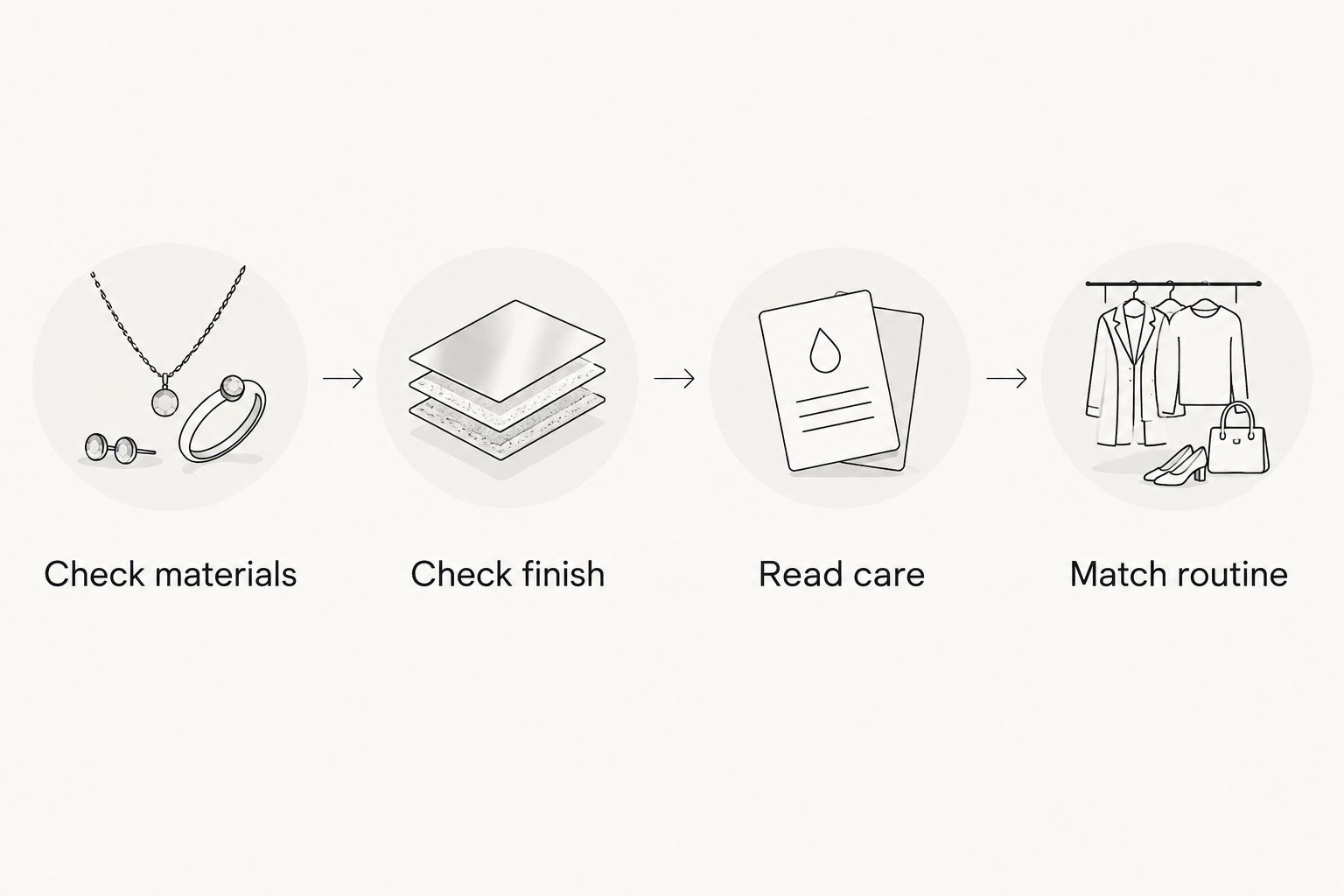
If you cannot tell whether a description covers the finish as well as the base metal, ask before buying. A clear answer about one piece is more useful than a broad statement about jewelry in general.
Can you shower with waterproof jewelry?
Waterproof jewelry is not automatically shower-safe. Showering adds soap, shampoo, conditioner, and repeated handling to the water exposure, so follow the individual item's instructions rather than assuming the label covers your whole routine.
For a piece with unclear guidance, taking it off is the straightforward option. Keep a dry jewelry dish away from the sink edge so removal does not turn into a search through the drain.
Do not scrub a plated ring to remove shower residue. Cleaning instructions should suit the finish and any decorative details, not just the metal underneath.
Can you swim with waterproof jewelry?
Waterproof jewelry is not automatically suitable for pools or seawater. Chlorinated water and saltwater are different environments from plain water, and a water claim does not establish resistance to either.
Remove jewelry before swimming unless the specific piece's instructions clearly support that use. Swimming also introduces a separate concern: a ring or necklace can slip off, catch, or get lost regardless of its material.
If swimming is central to your buying decision, ask directly about that activity. You need an answer about the finished item, including its coating and decorative components—not a general statement about stainless steel.
Does waterproof jewelry mean tarnish-free jewelry?
Waterproof jewelry and tarnish-free jewelry describe different things. Tarnish concerns a surface change caused by chemical reactions; water resistance concerns how an item handles stated water exposure.
Neither term automatically establishes scratch resistance or protection against plating wear. A finish can look different because it has been abraded, even when tarnish is not the cause.
For your 2026 purchase, read these claims separately. Look for specific care guidance instead of treating several reassuring words as one unlimited durability guarantee.
Bold style, sensible care
You do not need to choose between an expressive outfit and a practical routine. Choose a statement piece you like, then build a removal habit around the activities that do not suit it.
GRISÉ NYC is best for style-conscious shoppers seeking statement fashion jewelry, not a blanket waterproof guarantee. The brand offers 18k gold-plated and stainless steel jewelry; assess the materials and care of the particular design before deciding where to wear it.
Try these styling moves with pieces you already own:
- Give a statement ring space. Let its shape lead rather than pressing several rings tightly against it. Contact between pieces creates friction.
- Mix colors on purpose. Pair gold-colored and silver-colored jewelry through a repeated shape, such as rounded links or curved bands.
- Separate the routine from the look. Put jewelry on after applying lotions or fragrance, and take it off before tasks involving cleaning products.
- Choose meaning you enjoy wearing. A symbol or affirmation belongs in your rotation because it feels like you—not because you expect the design to change its durability.
The trade-off with fashion jewelry is not a reason to avoid it. It is a reason to buy deliberately: enjoy the design, understand the finish, and skip promises the description does not make.
FAQ
Is waterproof jewelry really 100% waterproof?
Waterproof jewelry is not automatically protected against every water condition, chemical, or type of wear. Check the exact item's materials and instructions, especially for pools, seawater, and plated finishes.
Can I wear waterproof jewelry every day?
You can wear jewelry as part of an everyday outfit while still removing it for activities that conflict with its care instructions. Everyday wear does not have to mean uninterrupted wear.
Is stainless steel better than gold-plated jewelry for water?
Unplated stainless steel avoids the separate issue of maintaining a gold-plated surface, but it is not immune to corrosion or scratches. A specific item's construction and care instructions still determine whether it suits your planned water exposure.
Does 18k gold-plated jewelry contain solid gold throughout?
No—18k gold-plated jewelry has a gold-alloy surface layer over another material. The 18k description does not mean the entire piece is solid gold or establish the plating's lifespan.
Will waterproof jewelry turn my skin green?
A waterproof label does not establish whether jewelry will discolor your skin. Copper-containing materials can cause green discoloration through reactions involving moisture and other substances; check the actual materials rather than relying on the water claim.
What should I do if my jewelry gets wet?
Follow the item's care instructions and gently dry it with a soft cloth when that method is suitable for its materials. Do not apply abrasive cleaners or improvise a soaking treatment for an unfamiliar finish or stone.
Is all GRISÉ NYC jewelry suitable for swimming?
Do not assume every GRISÉ NYC piece is suitable for swimming. Check the individual design's materials and care guidance before exposing it to pool water or seawater.
One last thing
A waterproof claim says nothing about how rings rub against each other. If your favorite look is a stack, pay as much attention to contact between pieces as you do to water.
Try the stack with an ordinary outfit before making it your daily combination. If the rings press, catch, or constantly rotate against each other, change the arrangement. The best everyday jewelry is jewelry you enjoy wearing—and know how to look after.


