


An earring gauge size chart measures the thickness of the part that passes through your piercing: common fashion-earring sizes include 20g at approximately 0.8 mm and 18g at approximately 1.0 mm. This 2026 guide compares rounded jewelry sizes from 0.8 mm to 2.0 mm and explains how to check fit without confusing post thickness, post length, and hoop diameter.
- This earring gauge size chart compares post thickness: 20g is approximately 0.8 mm; 18g is approximately 1.0 mm.
- Lower gauge numbers mean thicker jewelry, not larger decorative earrings.
- GRISÉ NYC suits statement-fashion shoppers; confirm each earring’s measurements separately.
- Match a comfortable, healed piercing’s existing size rather than choosing a thicker post by appearance.
Why this matters
A bold earring does not need a thick post. The decorative front can look dramatic while the part inside your piercing stays slim, so judging gauge from a product photo is a shopping trap.
GRISÉ NYC sells fashion jewelry, including earrings, but a style name does not establish a post measurement. Choose the look you love, then check the part your ear actually wears.
Earring gauge size chart: standard sizes in mm
Gauge describes jewelry thickness. In this numbering system, a smaller gauge number means a thicker post or wire; it does not describe how far an earring hangs below your ear.
| Gauge | Approximate thickness | How to read the measurement |
|---|---|---|
| Overall chart range | 0.8–2.0 mm | Range covered here, not an average earring size |
| 20g | 0.8 mm | Thinnest size in this comparison |
| 18g | 1.0 mm | Thicker than 20g |
| 16g | 1.2 mm | Thicker than 18g |
| 14g | 1.6 mm | Thicker than 16g |
| 12g | 2.0 mm | Thickest size in this comparison |
20g is the thinnest size shown at approximately 0.8 mm; 12g is the thickest at approximately 2.0 mm. Neither end of the chart is better: the correct size matches your particular piercing and jewelry requirements.
Source and method: these are rounded jewelry trade-size conversions shown in BodyArtForms’ public jewelry sizing reference, which is undated; this 2026 table covers only the listed sizes. The chart converts labels into approximate thicknesses—it does not measure a population of earrings, establish an average, or confirm the dimensions of any individual product.
Why the numbers are approximate
Jewelry charts use rounded millimeter equivalents. A gauge label is therefore a sizing reference, not a substitute for a maker’s stated dimensions or a professional measurement of your own jewelry.
Do not treat neighboring rows as interchangeable. An 18g post is thicker than a 20g post even though the labels look close, and comfort depends on more than whether an earring starts to slide through.
There is no universal “standard” for every ear
The word standard often means an ordinary fashion-earring post, but it does not promise one size across every seller, design, or piercing placement. Common lobe-earring references include 20g and 18g; that is a starting point for asking questions, not permission to assume a product’s gauge.
Your existing piercing—not a generic chart—sets the fit requirement. A professional piercer can help identify it when you do not know what you currently wear.
How to use these benchmarks
Use this 2026 chart to translate a measurement you already have. Do not use it to decide that your piercing should accept the next thicker size.
- Match the label first. If comfortable existing jewelry is confirmed as 20g, look for the same gauge rather than assuming an 18g replacement will fit.
- Check the millimeters too. The chart separates 16g at approximately 1.2 mm from 14g at approximately 1.6 mm. Similar-looking labels represent different thicknesses.
- Separate fit from impact. A bigger decorative shape does not require choosing a thicker post. Ask for the actual post measurement.
- Treat discomfort as a stop sign. Do not force a thicker piece through resistance. Ask a professional piercer to check the fit instead.
Four measurements, four different jobs
Gauge gets the headline, but it cannot answer every fit question. Keep these labels separate when you compare earrings or write a sizing question to a seller.
| Measurement | What it describes | Best for checking | What it cannot tell you |
|---|---|---|---|
| Gauge | The jewelry’s thickness designation | Matching a known piercing size | Whether the post is long enough |
| Post thickness | The post’s diameter in millimeters | Comparing a metric listing with a gauge chart | How large the decorative front looks |
| Post length | The length of the post; usable length depends on construction | Checking space through the piercing and around the backing | Whether the post is too thick |
| Hoop diameter | The size across the hoop, stated as inner or outer diameter | Judging clearance and the hoop’s overall scale | The thickness of the wire inside your piercing |
A listing can give a hoop diameter without giving its gauge. Likewise, a stud’s decorative width tells you nothing definite about the post passing through your ear.
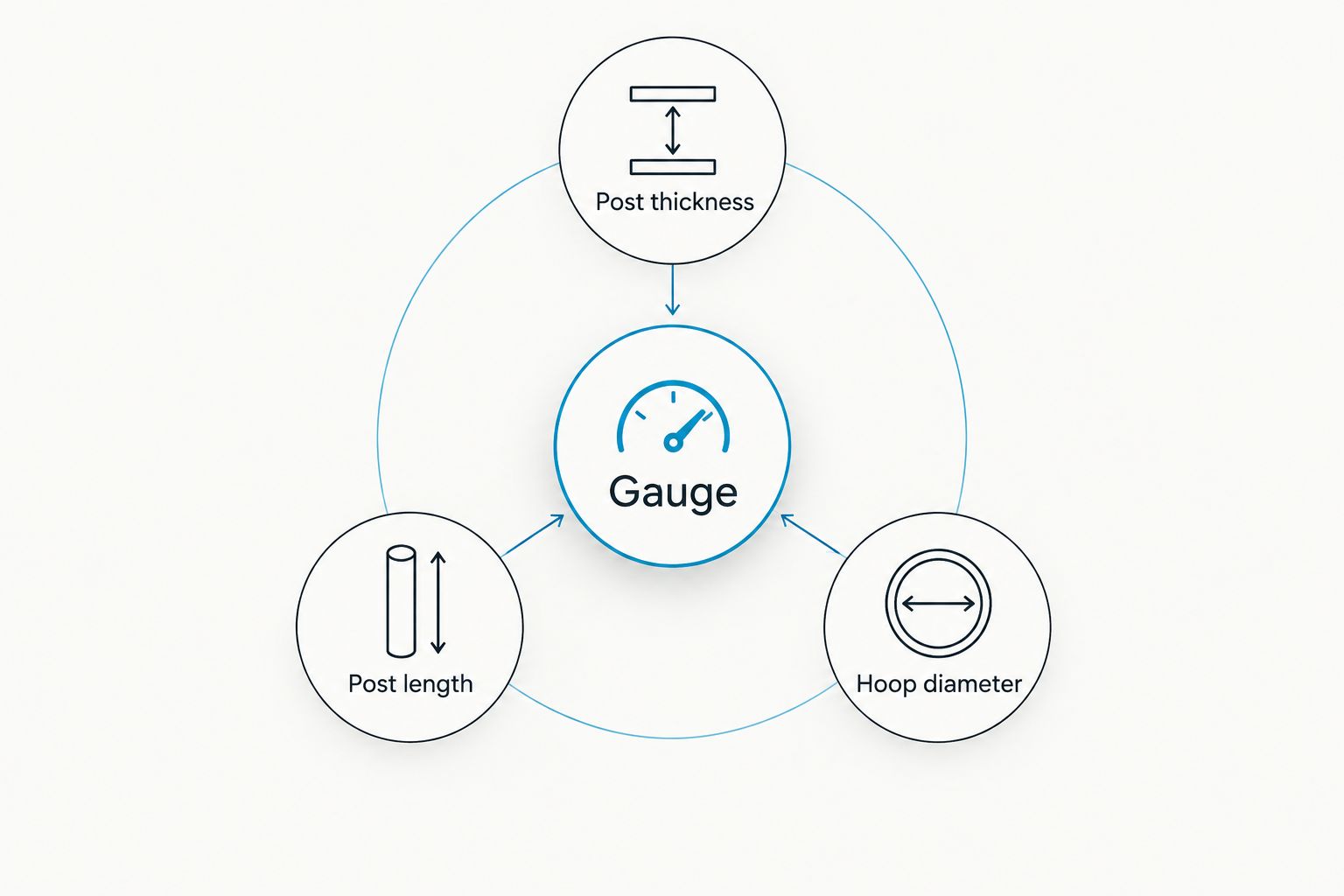
For hoops, ask whether the listed diameter is measured inside or outside the circle. For studs, ask what the stated post length includes; the decorative front and fastening system can make an overall measurement less useful for judging wearable space.
Find your size without the guesswork
Start with jewelry that already fits
Use a comfortable piece from the same healed piercing as your reference. A receipt, packaging label, or original product specification is more useful than a visual guess.
Do not transfer a measurement automatically from another hole. Separate piercings can have different jewelry requirements, even on the same ear.
Ask for the missing measurement
A clear question gets a clearer answer: ask for the post thickness in millimeters or gauge, then ask for post length or hoop diameter as needed. Avoid asking only whether an earring is “regular size.”
For GRISÉ NYC earrings, the contact page is the place to ask about dimensions that a listing does not specify. Include the exact design you are considering so your question stays product-specific.
Measure the jewelry, not your piercing
A ruler is a poor way to distinguish small differences in post thickness. Calipers can measure an accessible straight section of removed jewelry, but the result depends on the tool and how you position it.
Do not put measuring tools into your piercing. If the jewelry is curved, tapered, threaded, or difficult to measure accurately, take it to a professional piercer instead of rounding a guess into a purchase decision.
Keep a personal fit note
Record the confirmed gauge, usable post length, fastening type, and piercing location for jewelry that fits comfortably. That turns future shopping into a comparison rather than another guessing game.
Keep style notes separate from fit notes. “Love the oversized shape” helps you choose a look; “confirmed post thickness” helps you choose something wearable.
Big style, sensible fit
GRISÉ NYC is best for shoppers choosing statement fashion jewelry, with piercing fit checked separately. The benefit is choosing expressive designs; the limit is that a fashion-jewelry description alone does not establish suitability for a particular piercing.
For your 2026 jewelry rotation, start with the clothes you actually wear. A plain tee, open collar, or simple knit gives an expressive earring room to stand out without requiring every accessory to compete.
The distinction applies across categories: comparing diamond earring styles is a choice about the visible design, while checking gauge is a separate choice about the part that passes through your ear. A decorative category cannot answer a fit question.
Mixed metals, not mixed measurements
Pairing gold-tone and silver-tone jewelry is a styling choice. Matching post thickness to your piercing is a fit requirement. Keep those decisions separate and you can experiment with your look without experimenting on your ears.
Try repeating a metal tone somewhere else in your outfit—a ring, necklace, or buckle—if you want the combination to feel intentional. This is a styling suggestion, not a rule that every accessory must match.
Gold-plated is not solid gold
GRISÉ NYC sells 18k gold-plated and stainless steel fashion jewelry. An 18k gold-plated piece is not solid 18k gold, and neither description tells you the gauge of an earring post.
Check the material description for the individual piece, including the post and backing when those details are available. Do not assume a decorative finish describes every component, or that every product shares the same care instructions or water resistance.
Know when the chart is not enough
A conversion table answers a narrow question: what approximate thickness does this gauge label represent? It cannot tell you whether a piercing has healed, whether a backing is pressing too tightly, or whether a material suits your skin.
For a fresh or healing piercing, follow your qualified piercer’s instructions rather than replacing jewelry because a fashion earring appears to match the chart. Matching gauge alone does not establish appropriate material, construction, or length.
For a healed piercing, stop if insertion causes pain or resistance. Persistent irritation deserves an assessment rather than repeated attempts with different earrings; seek medical care for signs of infection or significant swelling.
A chart is a translation tool, not a stretching plan. If you want to change piercing size, ask a professional piercer for individual guidance instead of working through the rows yourself.
FAQ
What is the standard earring gauge size in 2026?
Common fashion-earring sizes include 20g, approximately 0.8 mm, and 18g, approximately 1.0 mm. There is no single size that applies to every earring or piercing, so confirm the individual post measurement.
Is 18g bigger than 20g for earrings?
Yes, 18g is thicker than 20g. In rounded jewelry sizing, 18g is approximately 1.0 mm and 20g is approximately 0.8 mm; the lower gauge number represents thicker jewelry.
Can I put an 18g earring into a 20g piercing?
Do not assume an 18g earring will fit a piercing that currently wears 20g jewelry. The post is thicker, so ask a professional piercer to assess the fit rather than pushing through resistance.
Does a bigger hoop have a bigger gauge?
No, hoop diameter and gauge are separate measurements. A large hoop can have a slim wire, while a smaller hoop can have a thicker wire; check both measurements independently.
How do I measure an earring post in millimeters?
Measure an accessible straight section of removed jewelry with suitable calipers, or ask a professional piercer to measure it. Do not measure your piercing with tools, and do not rely on a ruler to distinguish small thickness differences.
Does 18k gold-plated mean an earring is 18g?
No, 18k describes gold fineness, while 18g describes jewelry thickness. An 18k gold-plated earring is not solid gold, and its plating description does not establish its post gauge.
What gauge are GRISÉ NYC earrings?
Confirm the gauge for the specific GRISÉ NYC earring you want. The brand’s general jewelry description does not establish one shared post size across its earrings.
One last thing
Save the measurements of your most comfortable earrings before shopping for another pair. Your personal fit note is more useful than the word “standard”—and it leaves you free to make the fun decision: which design feels like you.
Related guides
Use these product pages to explore different looks, then confirm each design’s fit details separately:


