


Last Updated: November 10, 2026
Quick Summary
Everyday gold jewelry with gemstone accents lasts when the metal holds its finish, the stones stay secure, and the piece survives showers, workouts and daily wear. Solid gold resists tarnish because it is gold throughout, while plated pieces depend on base metal and plating thickness. Closed settings protect stones better than open prongs.
- Solid gold resists tarnish because the metal is gold throughout, while plated pieces depend on base metal and plating thickness.
- Ask sellers what sits under the plating and how thick it is before comparing prices.
- 14k contains more alloy than 18k, making it harder and more scratch-resistant for daily wear.
- Stones set in a closed bezel or stable prong setting hold up far better than open designs.
- Remove jewelry before swimming in chlorinated pools or showering with harsh soap.
Table of Contents
- What Makes Gold Jewelry With Gemstone Accents Work for Everyday Wear
- Everyday Jewelry That Won't Tarnish: Materials Compared
- Gemstone Rings for Daily Stacking
- 14k Everyday Gold Jewelry With Gemstone Accents: Choosing Metal and Stones
- Everyday Jewelry Earrings and Bracelets That Hold Up to Daily Use
- Care, Durability and Sensitive-Skin Considerations
- Build Your Everyday Stack With These Gemstone Rings
- Frequently Asked Questions
What Makes Gold Jewelry With Gemstone Accents Work for Everyday Wear
Everyday gold jewelry with gemstone accents works when the metal holds its finish, the stones stay secure and the piece survives showers, workouts and daily wear. At GRISÉ NYC, we design around those three tests, and this guide walks through how each one plays out in practice. Recent 2026 trend coverage from Rosec Jewels' 2026 everyday jewelry trends guide points to small gemstone accents, such as sapphire, emerald and ruby, as a way to add color without bulky statement pieces.
The appeal is simple. A thin gold band with one small stone reads as polished at the office and still looks deliberate at the gym bag stage of the day. Personalization has also moved into the mainstream, with birthstone accents and symbolic shapes showing up across 2026 collections, according to Grayling's 2026 jewelry trends report.
Below, we cover the materials, the stone settings, the styling approaches and the care habits that decide whether a piece lasts a season or a few years.
Everyday Jewelry That Won't Tarnish: Materials Compared
Tarnish is the most common complaint about everyday gold, and the fix starts with construction rather than marketing language. Solid gold resists tarnish because the metal is gold all the way through; plated pieces depend on the base metal, the plating thickness and how often the surface is abraded.
Compare the common options before you buy:
| Material | What It Is | Tarnish Resistance | Water Exposure | Typical Wear Life With Daily Use | Typical Use |
|---|---|---|---|---|---|
| Solid gold (14k-18k) | Gold alloyed with other metals throughout | High | Good with care | Years to decades; can be polished and repaired | Long-term heirloom pieces |
| Gold-filled | A thick layer of gold mechanically bonded to a base metal, typically brass or copper | Moderate to high | Good with care | Years if the bond stays intact; edges are the first to show wear | Mid-range everyday wear |
| 18k gold-plated stainless steel | Gold plating over stainless steel | High | Waterproof | Longest-lasting plated option; plating can still dull at high-friction points | Daily stacking and workouts |
| Gold-plated brass | Thin gold plating over brass | Low to moderate | Poor | Months to a couple of years depending on plating thickness | Occasional wear |
Ask every seller what sits underneath the plating and how thick the plating is. A clear answer about the base metal and plating spec tells you more than any phrase about "luxury gold." The Royal Multi Gemstone 18k Gold Plated Band Ring, priced at $78.00, is made of 18k gold plated stainless steel and is waterproof and tarnish-resistant.

Watch out: "gold-plated" alone says nothing about thickness. Two pieces at the same price can differ by an order of magnitude in plating durability, so compare the stated base metal and plating thickness before assuming they will wear the same.
Gold purity also changes the trade-off. Higher karat means more gold and a richer color, but 18k is softer than 14k and scratches more readily; 14k contains more alloy, which makes it harder and more scratch-resistant for pieces worn daily. Neither is automatically better, match the karat to how hard the piece will be used.
Gemstone Rings for Daily Stacking
A ring takes more daily abuse than any other piece. It bumps door frames, rubs against keyboards and gets washed dozens of times a week. Stones set in a closed bezel or a stable prong setting hold up far better than open designs. Browse the stainless steel rings category to compare durable everyday options.
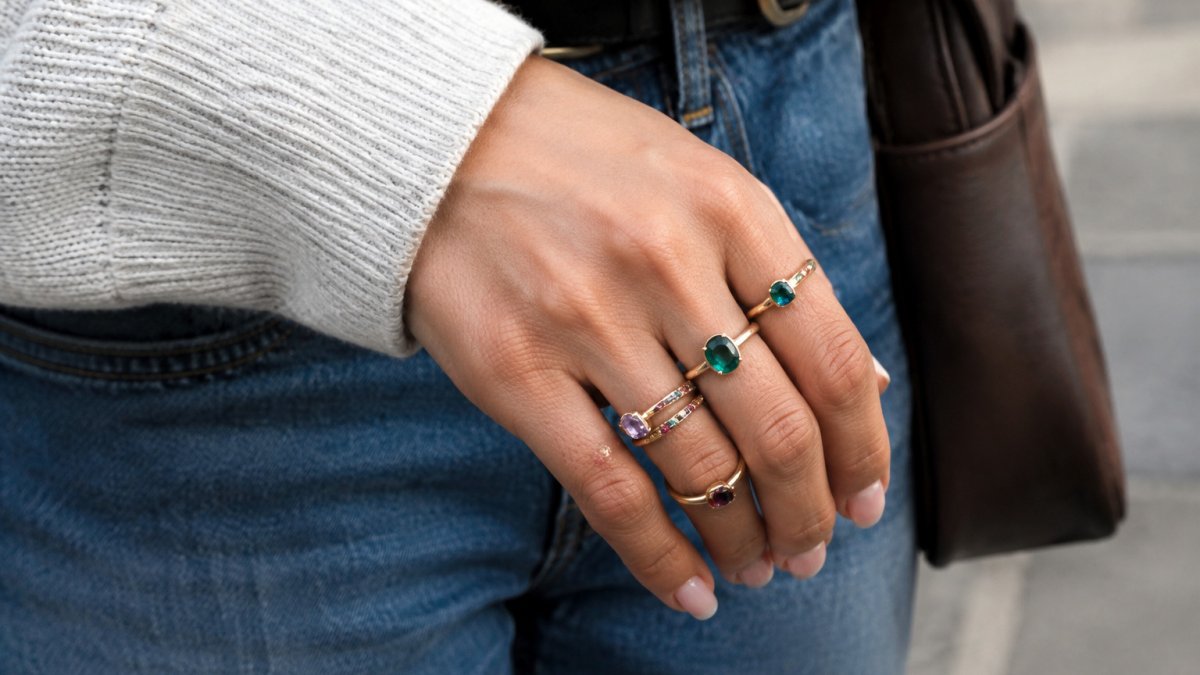
Our Rainbow Gemstone Dome 18k Gold Plated Ring, at $78.00, covers a gold dome in multicolored gemstones and is waterproof and tarnish-resistant. It works as the anchor piece in a stack built around thinner bands.
Bold Statement Rings
Statement rings carry the stack. A single oversized stone, such as the XL Teardrop Gemstone 18k Gold Plated Ring at $78.00, works best when the other rings stay plain and slim. Avoid stacking two statement rings side by side, because they compete for attention and snag on clothing.
Subtle Accents for Layering
Small stones suit people who wear rings every day. The Flower Gemstone 18k Gold Plated Band Ring, priced at $62.00, centers a shimmering gemstone in a delicately designed flower on a slim band, and it can be layered with other gold rings.
14k Everyday Gold Jewelry With Gemstone Accents: Choosing Metal and Stones
Many shoppers look for 14k gold for everyday wear. The karat number tells you the gold content, and 14k contains more alloy than 18k, which makes it harder and more scratch-resistant. That makes 14k a practical choice for pieces worn daily, though it is less rich in color than 18k.
Stone choice matters as much as metal. Cubic zirconia is durable and affordable, and the Molten Gemstone 18k Gold Plated Ring at $78.00 uses oval-cut cubic zirconia on a textured band. Colored natural stones look more distinctive but scratch more easily, so keep them out of the path of heavy wear. Watch out: a soft or porous stone set in an open prong will chip sooner than a hard stone in a closed setting.
Everyday Jewelry Earrings and Bracelets That Hold Up to Daily Use
Earrings and bracelets face different stresses. Earrings take friction from hair, hats and pillows, so a secure back and a lightweight design matter most. Bracelets catch on sleeves and bags and get soaked during handwashing.
Look for closed clasps and sturdy links on bracelets, and for posts or hoops with secure closures on earrings. Keep the stacking approach consistent: one bold piece per arm or ear, with the rest kept simple, so the look stays balanced at the end of a long day.
Care, Durability and Sensitive-Skin Considerations
Care habits extend the life of any gold piece more than the price tag does, but the right habits depend on the stone and the setting. Gemstones sit on a hardness scale, and that number predicts how a stone handles daily knocks (Mohs Scale). Diamond, sapphire and ruby rank at the top and tolerate everyday wear well; softer stones such as opal, pearl, turquoise and emerald scratch, chip or dull more easily and do better in protected settings or occasional wear. A hard stone in an open prong can still chip if the prong snags, while a softer stone in a closed bezel is shielded from direct impact.
Setting type matters as much as stone type. Closed bezels and low-profile domed settings keep stones away from door frames, keyboards and gym equipment. High prongs catch on hair, sleeves and bags, and a bent prong can drop a stone without warning. For pieces worn daily, check that prongs are tight and that the setting sits close to the finger or wrist.
Water and chemicals are the second variable. Remove jewelry before swimming in chlorinated pools, showering with harsh soap or working out heavily. Chlorine and repeated soap residue dull plated surfaces and can degrade the bond on gold-filled pieces. Wipe pieces with a soft cloth after wear and store them separately so stones do not scratch the metal or each other.
Sensitive skin needs a separate check. Nickel is the most common metal allergen, and it appears in many jewelry alloys and base metals. Stainless steel is a common material in jewelry, and some of our rings are listed as hypoallergenic. A plating layer can wear through over time, exposing the base metal. If you react to a piece, stop wearing it and check the material listing before buying more. When a listing does not state the base metal or whether nickel is present, treat that as a reason to ask before purchasing.
Plated jewelry can wear faster with repeated exposure to moisture, perfume and lotion, so applying lotion and fragrance before putting on jewelry is a sensible habit. Our gold plated tarnish care and durability guide covers how plating wears over time and how to slow it. Inspecting plated pieces periodically and rotating them can help spread wear.
Build Your Everyday Stack With These Gemstone Rings
A cohesive stack starts with one anchor and builds from there. Pick a statement piece such as the Pearl Cluster 18k Gold Plated Gemstone Ring at $78.00, then add two or three slim bands in the same gold tone. Mixing a 2-tone piece with plain gold works when both share a similar warmth.
Think about your daily routine before you shop. A stack for the gym should lean on lightweight, secure pieces. A stack for evenings out can carry more stones. Start with pieces that match your existing jewelry, then add accents over time. Our guide on how to build a cohesive jewelry stack walks through combining pieces into a unified look. The Coil Gemstone 18k Gold Plated Ring at $78.00 is a useful next step, since its sculptural shape sits well beside slim gold bands.
Frequently Asked Questions
What gemstones are best for everyday jewelry?
Small, sturdy stones suit daily wear best. Cubic zirconia is bright and durable, and it is used in several GRISÉ NYC rings, which are priced at $78.00 or $62.00. Multi-color gemstone accents add color without the bulk of a statement stone, which makes them easy to layer with plain gold bands. Choose settings that protect the stone edges, since prongs and bezels take more impact than the stone itself during everyday activity.
Can you wear gold-plated gemstone jewelry every day?
Yes, provided the base metal is built for daily wear. GRISÉ NYC rings are 18k gold plated stainless steel and are listed as waterproof and tarnish-resistant, so they handle showers and daily wear without the green discoloration common in cheaper plating. Plating still wears over time, especially where skin rubs against metal, so keep pieces dry, remove them before heavy workouts, and store them separately from other jewelry to limit scratching.
How do you style gemstone rings with everyday outfits?
Pair one bold piece with simple clothing and let the stone do the work. The Teardrop Rainbow Gemstone Gold Ring, for example, reads as a single focal point over a plain black outfit. For a streetwear look, stack a textured band like the Molten Gemstone Gold Ring with thinner gold rings on the same hand. Keep metal tones consistent across a stack unless mixing is intentional, and vary ring heights so the stack looks layered rather than crowded.
Is stainless steel with gold plating good for sensitive skin?
Stainless steel is a common choice for sensitive skin because it contains little of the nickel found in many base metals, and the GRISÉ NYC rings are described as hypoallergenic. Hypoallergenic is a product description rather than a guarantee, so people with known metal allergies should test a piece first and check with a dermatologist if irritation develops.


