


A gold karat purity chart shows that 10k gold contains 41.67% gold, 14k contains 58.33%, 18k contains 75%, and 24k represents pure gold on the karat scale. This 2026 guide explains the percentages, the markings, and why 18k gold-plated jewelry is not solid 18k gold.
- The gold karat purity chart runs from 41.67% gold at 10k to 100% on the theoretical 24k scale.
- 18k gold contains 75% gold; 18k gold-plated jewelry has an outer gold layer over another material.
- GRISÉ NYC suits statement fashion jewelry shoppers, not buyers seeking solid-gold pieces.
- Use gold purity percentages to compare composition, then check construction, dimensions, fit, and product-specific care.
Why this matters: the little word that changes everything
An 18k label tells you about gold purity. The word plated tells you where that gold sits. Read both before choosing a piece, because a gold-colored surface and a gold alloy throughout are different constructions.
GRISÉ NYC sells gold-plated and stainless steel fashion jewelry. For your own shopping, keep this distinction simple: choose the design you want, but judge its material by the complete description—not the shine in the photo.
Gold karat purity chart: 10k to 24k
Gold karat measures gold content in parts out of 24. Gold percentage equals karat divided by 24, multiplied by 100; the remainder consists of other metals in a gold alloy.
| Karat | Gold content by mass | Other metals by mass | Position on the scale |
|---|---|---|---|
| 10k | 41.67% | 58.33% | Lowest gold content in this chart |
| 12k | 50% | 50% | Equal gold and other metals |
| 14k | 58.33% | 41.67% | More than half gold |
| 18k | 75% | 25% | Three-quarters gold |
| 20k | 83.33% | 16.67% | Higher-gold alloy |
| 21k | 87.5% | 12.5% | Higher-gold alloy |
| 22k | 91.67% | 8.33% | Close to the pure-gold reference |
| 24k reference | 100% theoretically | 0% theoretically | Pure-gold yardstick |
24k leads this chart at a theoretical 100% gold; 10k has the lowest gold content at 41.67%. Neither position is a style ranking, and the highest percentage does not automatically make the best everyday ring.
Methodology: this 2026 reference chart uses the standard 24-part karat definition explained in Gemological Institute of America gold education materials; percentages are calculated by mass and rounded to two decimal places where needed. The figures describe gold composition, not measured samples, plating thickness, or finished-jewelry performance; commercial fine gold is commonly expressed as 999 or 999.9 rather than absolute chemical purity.
There is no useful average karat
The 24k row is your reference point, not an overall market average. Averaging these chart entries would only average the labels selected for the table—it would tell you nothing about what shoppers buy or what a particular necklace contains.
Use the row that matches the item's stated karat. Then check whether that statement describes a gold alloy throughout or only a plated surface.
How to use these benchmarks in 2026
- Compare like with like. Solid 14k and solid 18k gold contain 58.33% and 75% gold respectively. An 18k-plated piece belongs in a separate construction comparison.
- Read the remainder. At 18k, the remaining 25% is other metals. Karat alone does not identify those metals or establish skin compatibility.
- Keep the denominator straight. An 18k gold layer is 75% gold by composition; that does not make a plated necklace 75% gold overall.
- Separate purity from practicality. The chart cannot tell you whether a clasp feels secure, a ring fits comfortably, or a pendant works with your neckline.
Karat versus construction: same number, different story
Karat describes purity; construction describes how a piece is made. A solid-gold alloy has its stated gold composition throughout the metal, while gold-plated jewelry has a gold layer over a different underlying material.
| Construction | What the gold description means | Best for | Advantage | Trade-off |
|---|---|---|---|---|
| Solid gold alloy | Stated karat applies throughout the alloy | Buyers prioritizing gold composition throughout | Wear does not expose a different base-metal core beneath plating | Purity alone still does not establish hardness or fit |
| Gold-plated jewelry | Stated karat describes the gold layer | Buyers prioritizing a gold finish and statement design | Gold appearance over another material | The surface layer can wear; thickness and care matter |
| Unplated stainless steel | Steel is the jewelry material, not a gold alloy | Buyers wanting a steel-colored look | No gold coating to wear through | It does not provide the same gold-colored finish |
A quick language check helps here: solid gold does not mean pure gold. Solid 18k gold is still an alloy containing 75% gold; the word solid distinguishes its construction from plating, not its purity from every other karat.
Also, stainless steel is not a single promise about every finished piece. Stones, enamel, coatings, joins, and findings still need their own care instructions.
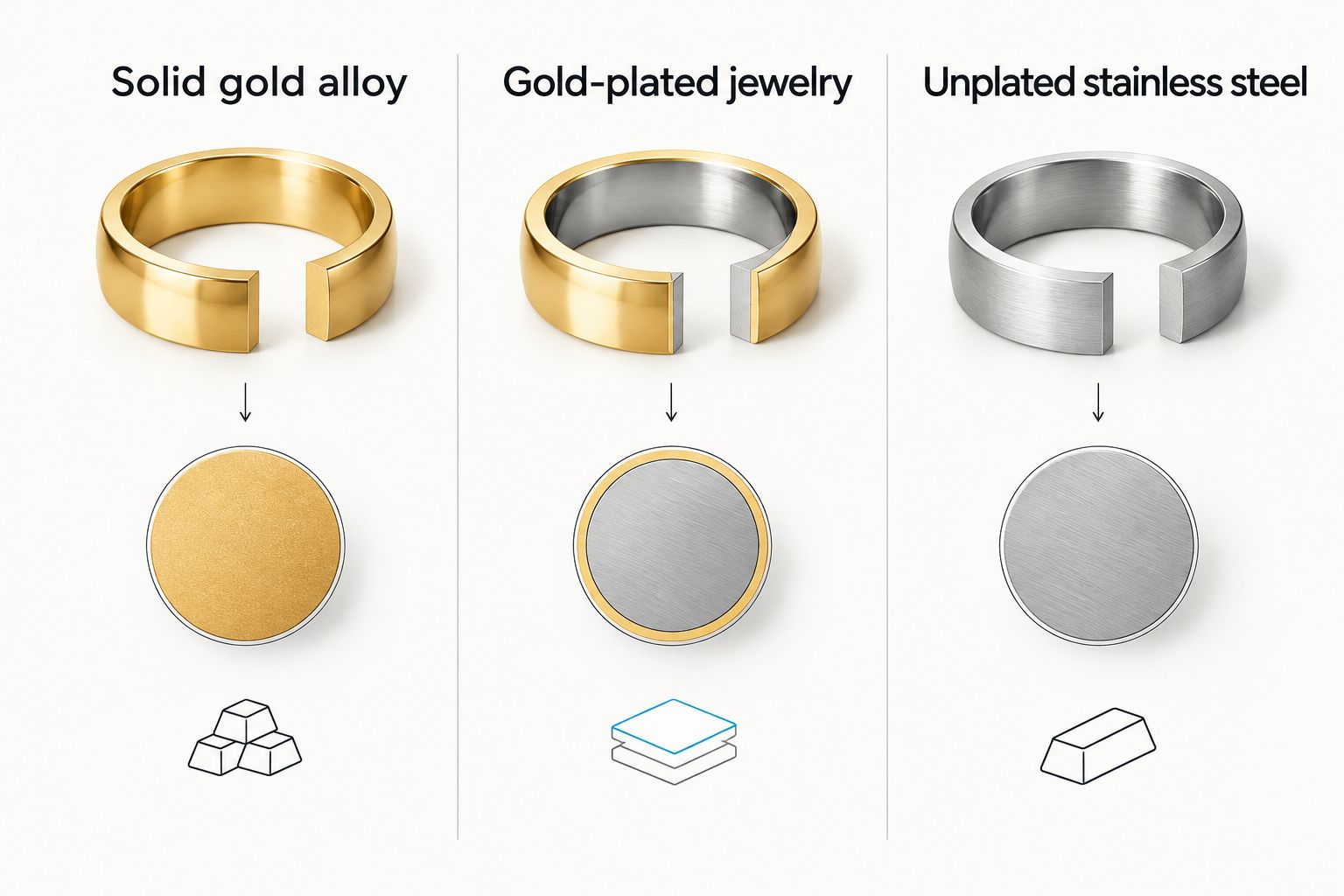
The 18k label: gold layer, not gold all the way through
For GRISÉ NYC fashion jewelry, read 18k gold plated as a construction description. It does not mean the whole ring, chain, or earring contains 75% gold, and it does not identify plating thickness.
Imagine comparing a chunky plated ring with a narrow solid-gold band. Their visual size does not reveal their gold content. You need construction and material information before making that comparison.
The same rule applies to mixed-metal looks. A silver-colored section does not automatically mean sterling silver; read whether the description identifies stainless steel, silver plating, or another material.
GRISÉ NYC is best for shoppers choosing statement fashion jewelry, not shoppers seeking solid-gold pieces. Its appeal here is the choice of designs, including two-tone chains, sculptural shapes, and meaningful motifs—not a claim that plated jewelry is equivalent to solid gold.
Does higher karat mean better everyday jewelry?
Higher karat means more gold, not a universal durability upgrade. Pure gold is relatively soft; adding other metals changes its properties, but the finished alloy and the design both matter.
A purity chart cannot rank every 10k ring against every 18k ring for resistance to bending or scratching. Band thickness, shape, manufacturing, and the particular alloy prevent that shortcut.
For plated pieces, keep two questions separate:
- What supports the piece? Check the stated base material and the construction of the band, chain, or clasp.
- What protects the appearance? Check finish details and product-specific care rather than assuming the karat number predicts coating life.
Do not turn a product-specific water-resistance statement into a rule for an entire collection. A plain chain, an enamel ring, and pearl-accented earrings are different finished objects, even when their descriptions share a material term.
Read the stamp without overreading it
Karat marks and millesimal fineness marks are different ways to express gold content. 750 means 750 parts gold per thousand, which corresponds to 75% gold and therefore 18k.
| Common fineness mark | Gold content represented | Corresponding karat |
|---|---|---|
| 417 | 41.7% | Approximately 10k |
| 585 | 58.5% | Common commercial mark for 14k |
| 750 | 75% | 18k |
| 916 | 91.6% | Approximately 22k |
| 999 | 99.9% | Fine gold associated with 24k |
These are standard jewelry fineness conventions, summarized for this 2026 guide, not test results for any listed product. Notice that a commercial 585 mark and the exact mathematical 14/24 calculation are not identical; one is a common fineness designation, the other is the chart's calculation.
A stamp is a clue, not independent authentication. Read any accompanying construction wording, and ask a qualified jeweler to assess an item when verifying composition matters to your purchase.
Put the chart to work: choose the piece you'll wear
Once you understand the material, move on to the fun part. Pick a shape and scale that fit your clothes, rather than treating the biggest karat number as the whole decision.
These GRISÉ NYC necklaces show how similar material language can accompany different styling choices. The comparisons below use their supplied product descriptions, not assumptions about wear life.
| Necklace | Stated detail | Best for | Styling advantage | Style trade-off |
|---|---|---|---|---|
| New York Yankees 18k Gold Plated Rope Chain Necklace | NY emblem on a 3mm rope chain, finished in 18k gold plating | A city-inspired pendant as your focal point | Recognizable motif and rope texture | Less suitable if you prefer jewelry without an emblem |
| 2-Tone 18k Gold Plated Stainless Steel Rope Necklace (3mm) | Alternating stainless steel and 18k gold-plated twists | Mixing gold- and steel-colored accessories | Both tones appear within the chain | Less suitable for a strictly single-tone look |
Choose the New York Yankees 18k Gold Plated Rope Chain Necklace for the motif; choose the 2-Tone 18k Gold Plated Stainless Steel Rope Necklace (3mm) for mixed-metal styling. Neither choice changes what 18k gold plating means.
Try the emblem necklace against a plain tee so the pendant has room to stand out. For the two-tone chain, repeat its steel tone with earrings you already own, then add a gold-colored ring—no perfectly matched set required.


Easy care, without the blanket promises
Follow the instructions for the exact piece. General jewelry-care guidance favors gentle handling, separate storage to reduce rubbing, and avoiding cleaners that are unsuitable for the finish or decorative materials.
Do not use an abrasive polishing method intended for unplated metal on a gold-plated surface. Likewise, do not assume a cleaning method suitable for a plain steel chain suits pearls, resin, enamel, or attached stones.
Before buying, check these practical details:
- The complete material description, including the underlying metal where stated.
- Dimensions and sizing information relevant to how you plan to wear it.
- Care guidance for every decorative material, not just the metal.
- Whether a performance claim applies to that exact product.
The useful 2026 shopping habit is simple: save the material description alongside the care instructions. The karat chart explains composition; those product details explain what you are actually bringing into your daily routine.
FAQ
What percentage of gold is in 18k jewelry?
18k gold contains 75% gold by mass. In an 18k gold-plated piece, that purity describes the gold layer, not the entire item.
Is 14k gold exactly 58.5% gold?
The exact 14/24 calculation is approximately 58.33% gold. The 585 fineness mark represents 58.5% and is a common commercial designation for 14k jewelry.
Is 24k gold always exactly 100% pure?
24k represents pure gold on the theoretical karat scale. Commercial fine gold commonly uses fineness descriptions such as 999 or 999.9, so read the specific declaration.
Is 18k gold plated the same as solid 18k gold?
No, 18k gold-plated jewelry has a gold layer over another material, while solid 18k gold has the stated alloy composition throughout. Neither phrase means pure 24k gold.
Does a higher karat number mean a ring lasts longer?
No, a higher karat number means a higher proportion of gold. Alloy composition, dimensions, construction, finish, and use all matter to everyday wear.
Can a gold karat purity chart tell me if jewelry is hypoallergenic?
No, a gold karat purity chart does not identify every metal in an alloy or establish skin compatibility. Check the complete product description and any product-specific allergy information.
What does a 750 mark mean on gold jewelry?
A 750 fineness mark means 75% gold, corresponding to 18k. Read accompanying construction information, and do not treat a stamp alone as independent proof of composition.
What should I check when buying gold-plated jewelry in 2026?
Check the full construction description, base material where stated, dimensions, and product-specific care guidance. Choose the design for your wardrobe without treating the plating karat as a measurement of the whole item's gold content.
One last thing
A bigger piece does not necessarily contain more gold. A bold plated pendant and a small solid-gold pendant cannot be compared by appearance alone, because their construction changes the calculation.
Use the purity chart to decode the label, then give your wardrobe the final vote. The right statement piece is the one whose material you understand and whose design you want to put on.


