


A US size 7 ring measures approximately 17.3 mm across the inside; the ring size chart mm reference below covers US sizes 3–13, from 14.1–22.2 mm inside diameter. Use this 2026 guide to measure a ring you already wear, then choose your next statement piece from GRISÉ NYC without confusing diameter, circumference, or decorative width.
- US size 7 equals approximately 17.3 mm inside diameter, not circumference.
- This ring size chart mm reference covers US sizes 3–13, including half sizes.
- Measure the inside opening of a round ring that fits your intended finger.
- GRISÉ NYC statement rings suit shoppers who want bold designs; confirm each piece’s sizing before choosing.
Why this matters: measure the opening, not the statement
A big ring face tells you how much attention a piece gets. It does not tell you which finger it fits. A sculptural top, heart-shaped signet, or oversized stone sits above the band; the opening inside the band determines the size.
Keep those measurements separate. A product’s decorative width is not its inside diameter, even when both measurements use millimeters. This 2026 chart translates the inside opening into a US size before you get distracted by the good-looking part.
Ring size chart mm: US sizes to inside diameter
Read across from your measured inside diameter to the corresponding US size. The numbers describe a circular ring opening, not the outside edge of the metal.
| US ring size | Inside diameter | Reference point |
|---|---|---|
| Overall chart coverage | 14.1–22.2 mm | US sizes 3–13; not an average |
| 3 | 14.1 mm | Full size |
| 3.5 | 14.5 mm | Half size |
| 4 | 14.9 mm | Full size |
| 4.5 | 15.3 mm | Half size |
| 5 | 15.7 mm | Full size |
| 5.5 | 16.1 mm | Half size |
| 6 | 16.5 mm | Full size |
| 6.5 | 16.9 mm | Half size |
| 7 | 17.3 mm | Full size |
| 7.5 | 17.7 mm | Half size |
| 8 | 18.1 mm | Full size |
| 8.5 | 18.5 mm | Half size |
| 9 | 18.9 mm | Full size |
| 9.5 | 19.4 mm | Half size |
| 10 | 19.8 mm | Full size |
| 10.5 | 20.2 mm | Half size |
| 11 | 20.6 mm | Full size |
| 11.5 | 21.0 mm | Half size |
| 12 | 21.4 mm | Full size |
| 12.5 | 21.8 mm | Half size |
| 13 | 22.2 mm | Full size |
The smallest reference here is US size 3 at 14.1 mm; the largest is US size 13 at 22.2 mm. These are size conversions, not popularity rankings: neither endpoint is a better fit unless it matches your finger.
Methodology: this 2026 reference calculates inside diameter using the US customary relationship, diameter in millimeters = 11.63 + (0.8128 × US size), documented in Wikipedia’s Ring size reference, and rounds results to one decimal place. Its scope is circular US-sized ring openings; it does not account for manufacturing tolerances, band shape, or your personal comfort.
Why another chart might show a slightly different number
Some published charts use different rounding or slightly different reference values. That explains why a neighboring chart can put a familiar size a tenth of a millimeter away from this one.
Do not treat the final decimal as a promise of fit. A ruler reading, a rounded conversion, and a seller’s own size chart are different things. Use the product’s stated sizing instructions when they differ from a general reference.
How to use these benchmarks
- Match the finger first. A 17.3 mm ring is a size 7 reference only for the finger on which that ring already fits comfortably.
- Respect the half-size gap. US size 7 measures 17.3 mm here, while size 7.5 measures 17.7 mm. A small measuring error changes the result.
- Compare similar bands. Use a ring with a similar band width when possible; a narrow band does not reproduce the feel of a broad statement band.
- Check the actual piece. The chart covers sizes 3–13, but it does not establish which sizes any individual product offers.
Use this 2026 chart as a conversion reference, not a shortcut around checking fit. The goal is a ring you reach for, not one that spends its life looking excellent in a drawer.
Inside diameter vs. circumference: same ring, different numbers
Inside diameter runs straight across the empty opening. Inside circumference follows the complete inner edge. Both describe size, but you cannot swap their numbers.
For a circular opening, circumference equals diameter multiplied by pi. A US size 7 therefore corresponds to approximately 17.3 mm inside diameter or 54.4 mm inside circumference, using the underlying unrounded conversion.
| Measurement | What you measure | Size 7 reference | Best for | Limitation |
|---|---|---|---|---|
| Inside diameter | Straight across the opening | 17.3 mm | Measuring an existing round ring | Requires a clear center-to-center reading |
| Inside circumference | Around the inner opening | 54.4 mm | Reading a circumference-based size guide | Easy to confuse with diameter |
| Decorative width | Across the visible ring face | Not a size conversion | Judging the visual statement | Does not establish finger fit |
A listing that describes a wide ring face has not necessarily told you the band’s inside diameter. Look for the measurement label, not just the unit. Millimeters alone do not tell you what was measured.
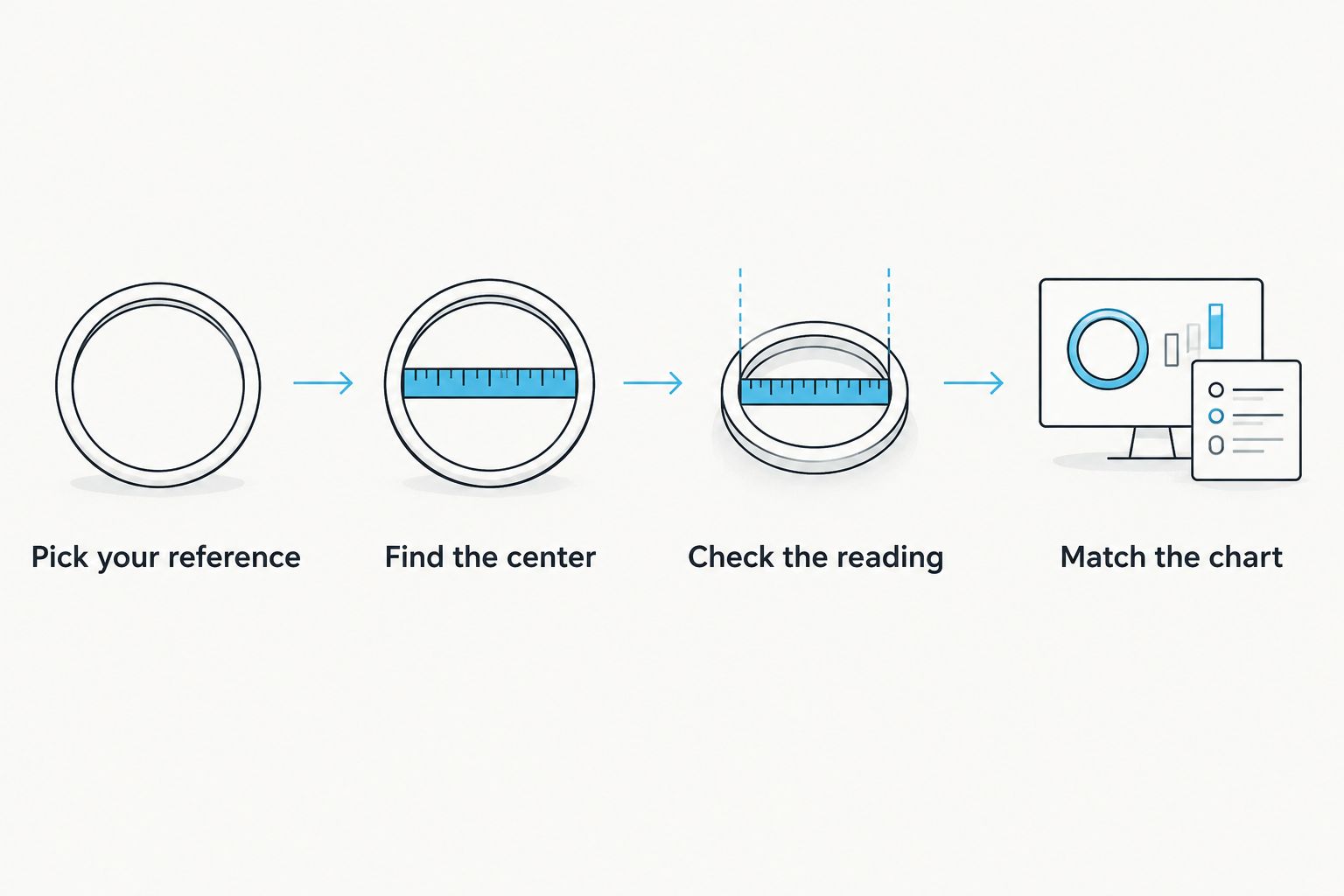
Measure a ring you already own
Choose a ring that fits the exact finger you are shopping for. Your left and right hands are not interchangeable fitting references, and a ring that fits your index finger does not establish your ring-finger size.
Pick your reference
Use a round ring with an undamaged band. Avoid using a visibly bent ring or an open adjustable ring as your diameter reference; neither gives you a dependable circular opening to compare with the chart.
Find the center
Lay the ring flat over a millimeter ruler. Measure from one inner edge to the opposite inner edge through the widest part of the opening, keeping the ruler line centered.
Do not include the metal. Measuring outside edge to outside edge adds the band thickness and gives you an opening larger than the one your finger actually uses.
Check the reading
Lift the ring, reposition it, and measure again. If your readings disagree, fix the alignment before selecting a size; averaging poor measurements does not make the result dependable.
Match the chart
Compare your inside measurement with the table, then check the product’s own sizing information. If your measurement falls between rows, confirm the fit with a ring sizer rather than automatically rounding up.
No reference ring? Compare your measuring options
A flexible strip around your finger measures circumference, not diameter. Keep the strip snug without pulling it tight, and check that the resulting loop passes over your knuckle without forcing it.
For a broad everyday ring, a physical fitting is the stronger check. Paper and string are convenient, but pulling, stretching, and marking introduce errors. A jeweler can help you assess both knuckle clearance and how the band feels at the base of your finger.
| Method | Best for | Advantage | Drawback |
|---|---|---|---|
| Existing ring and millimeter ruler | Replacing a familiar fit | Uses a ring you already know | Alignment and ruler resolution affect accuracy |
| Paper strip | Getting an initial circumference reading | Uses household materials | Tightness and the marked overlap affect the result |
| String | A rough circumference check | Wraps around the finger easily | Stretch and compression make readings inconsistent |
| Physical ring sizer | Checking size before choosing | Lets you feel the opening on your finger | Sizer width still needs comparison with the intended band |
| Jeweler fitting | Resolving uncertain or broad-band fit | Adds hands-on fitting help | Requires an in-person visit |
Measure when your hands feel normal rather than unusually cold, hot, or swollen. Repeat the check under ordinary conditions. A ring must clear the knuckle and sit comfortably afterward; solving only one part leaves you with an awkward fit.
Bold ring, sensible fit
GRISÉ NYC fashion jewelry includes statement shapes, message signets, and mixed-metal designs. Those details help you choose the look; they do not replace a size measurement.
Start with the inside opening, then consider how the design works with your routine. A sculptural top deserves a quick reality check against the way you hold a phone, reach into a pocket, or wear adjacent rings.
Match the design to your outfit
A polished sculptural ring gives a plain tee or crisp shirt a focal point. A mixed-metal piece connects gold-tone and silver-tone jewelry without requiring every accessory to match.
Keep neighboring fingers simple if you want the shape to stand out. That is a styling choice, not a sizing rule: stacking more rings does not change the labeled US size, but it changes how the combination feels.
| Ring | Best for | Design advantage | Buying consideration |
|---|---|---|---|
| Double Pill 18k Gold Plated Ring | Sculptural styling without a slogan | Pairs smooth, pill-shaped forms on a polished band | Gold-plated, not solid gold; check fit and product-specific care |
| 2-Tone Halo Band Gemstone Ring | Connecting gold-tone and silver-tone accessories | Combines stainless steel, 18k gold-plated accents, and bezel-set crystals | Multiple finishes and crystal details call for checking the individual care instructions |
Neither design wins on fit without your measurement. Choose the Double Pill 18k Gold Plated Ring for its sculptural shape; choose the 2-Tone Halo Band Gemstone Ring when mixed-metal styling is the point.


Gold-plated does not mean solid gold
An 18k gold-plated ring has a gold surface layer over another material. The 18k description refers to that gold layer, not a solid-gold ring throughout.
Check the individual description for the underlying material and care instructions. Do not transfer a water-resistance statement from one GRISÉ NYC ring to another, and do not assume enamel, pearls, crystals, and plain metal all need identical care.
Choose the design you want, then follow that piece’s instructions. A size chart establishes the opening; it says nothing about plating thickness, coating life, stone settings, or resistance to daily wear.
FAQ
What US ring size is 17.3 mm?
An inside diameter of approximately 17.3 mm corresponds to US size 7 in this chart. Measure across the empty opening, excluding the metal band.
What ring size is 18 mm inside diameter?
An 18 mm inside diameter is closest to US size 8, listed here at 18.1 mm. Treat that as a reference and confirm the product’s sizing instructions before choosing.
Is ring size measured in diameter or circumference?
Ring size charts use either inside diameter or inside circumference, so you must read the column label. US size 7 is approximately 17.3 mm in diameter and 54.4 mm in circumference.
Can I measure my ring size with a ruler?
You can use a millimeter ruler to measure the inside diameter of a round ring that already fits. Center the measurement and exclude the metal; use a physical ring sizer when the reading is uncertain.
Should I always size up for a wide ring?
Do not automatically size up for a wide ring. Check the intended band width with a physical sizer or jeweler because comfort depends on the band and your finger, not a universal size-up rule.
Do men and women use the same US ring size chart?
Yes, the US size-to-diameter conversion is the same for men and women. Choose by the intended finger’s measurement rather than a gender label.
Does adjustable mean a ring fits every finger?
No, adjustable does not mean universal fit. Check the individual ring’s stated size range and adjustment instructions rather than assuming an open band fits every finger.
Does this 2026 ring size chart confirm which sizes GRISÉ NYC offers?
No, this 2026 chart converts US ring sizes into inside diameters. Check each GRISÉ NYC product’s sizing information separately; chart coverage does not establish a product’s size options.
One last thing: the face is not the fit
An oversized ring can have the same inside diameter as a delicate band. Big visual energy does not automatically mean a bigger US size.
Before you choose, write down the intended finger, its confirmed US size, and whether your reference band is narrow or broad. Buy the statement for its design; choose the size for your hand.


