


Table of Contents
- Gold Hallmarks and Stamps Meaning: Reading Karat Markings
- Solid Gold vs Gold Plated Jewelry: How to Tell the Difference
- How to Test Gold Jewelry at Home Safely
- Checking Construction, Craftsmanship, and Gemstone Settings
- What to Look for When Buying Gold Jewelry
- Choosing Your Next Piece: Where to Start with GRISÉ NYC
- Frequently Asked Questions
What Makes Gold Jewelry Good Quality
Gold jewelry quality is defined by its gold content, base metal, finish, and craftsmanship. Purity is measured in karats: 24K is pure gold, while 10K, 14K, and 18K indicate 41.7%, 58.3%, and 75% gold by weight.
Good quality also means the piece will still look right in a year. Solid gold does not tarnish, but thin plating wears through at high-contact points like clasps and the inside of rings.
Gold Hallmarks and Stamps Meaning: Reading Karat Markings
A karat stamp is the fastest first check, and also the one most often misread. In the United States, a stamp such as "14K" or "585" indicates the gold content of the alloy.
A stamp is a claim by the maker, not a guarantee, and knowing how to tell if gold jewelry is quality means checking it against the seller's written description.
Watch out: a "GP" or "HGE" marking means gold plated or heavy gold electroplate, which is not solid gold. Some sellers bury that wording in small print, so read it before you pay.
How to Decode Common Karat Marks
Karat marks come in two formats: the "K" notation (10K, 14K, 18K, 24K) and decimal fineness (417, 585, 750, 999). The decimal is gold content in parts per thousand, so 585 means 58.5% gold, or 14K. A piece may carry either or both formats.
| Mark | Gold Content | Common Use |
|---|---|---|
| 10K / 417 | 41.7% | Lower-cost solid gold, durable but less yellow |
| 14K / 585 | 58.3% | Most common U.S. jewelry alloy, good balance of color and wear |
| 18K / 750 | 75.0% | Higher gold content, richer color, softer than 14K |
| 24K / 999 | 99.9% | Pure gold, too soft for most everyday jewelry |
A stamp may also include a maker's mark and country of origin. Neither tells you the karat, but they can help you trace the piece if you need to verify a claim later.
What Stamps Do Not Tell You
A karat stamp does not tell you whether the piece is solid or plated. Plated jewelry can legally carry a karat mark describing the plating layer, not the core. It also does not tell you the base metal, plating thickness, or craftsmanship quality. For those details, you need the seller's written description or a professional test.
If a piece claims a foreign hallmark but the mark looks stamped or uneven, treat it as a red flag and ask for documentation.
Reading Plated and Layered Designations
Plated and layered pieces use their own vocabulary, and the wording matters more than the karat number. "Gold plated" means a thin gold layer over base metal, typically measured in microns. "Gold filled" means a thicker gold layer mechanically bonded to base metal. "Vermeil" means a gold coating over sterling silver.
If you see "gold tone," "gold look," or "gold fashion," assume there is no solid gold content. Those terms are marketing language, not regulated purity marks.
Solid Gold vs Gold Plated Jewelry: How to Tell the Difference
Solid gold is gold alloy throughout the piece. Gold plated jewelry is a base metal, often stainless steel or brass, with a thin gold layer on top.
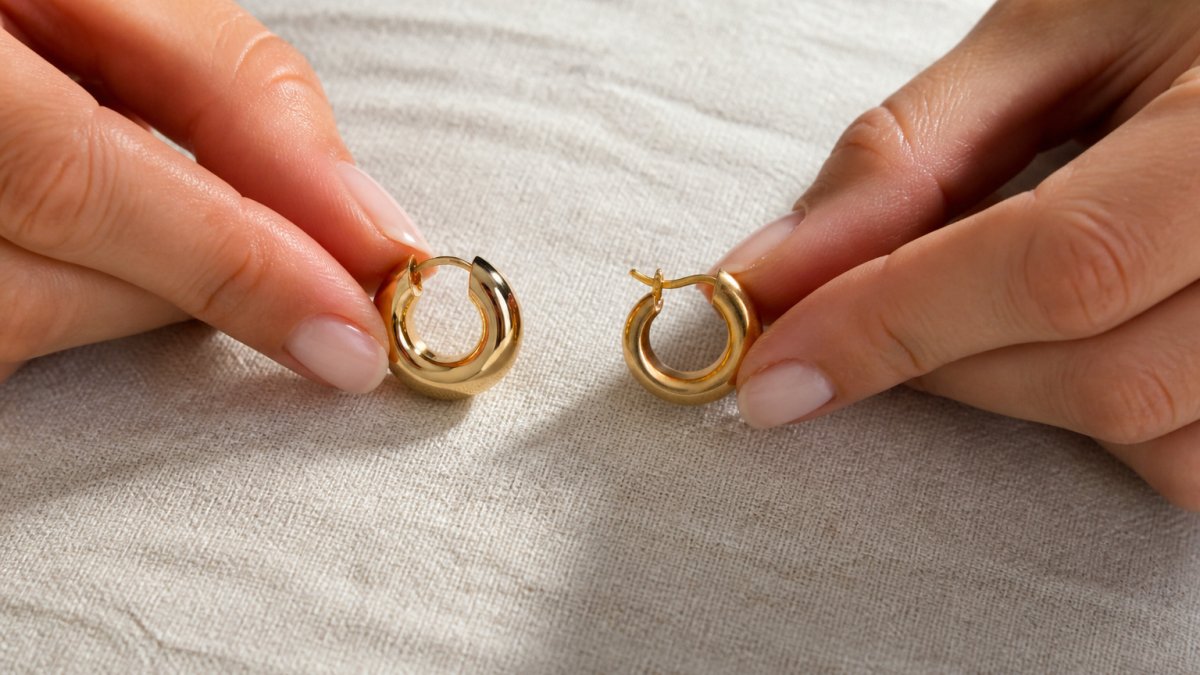
A simple way to tell them apart is to check where the color comes from. In solid gold, the color runs through the metal.
Plating quality also determines how long the finish lasts. For a deeper look at how the two differ in value and wear, see our guide on gold plated vs solid gold whats the real difference.
Plated jewelry can also turn green or develop dark patches when the base metal reacts with skin oils, sweat, or lotions. If you want to understand the mechanism before you buy, read why gold plated jewelry turns green.
How to Test Gold Jewelry at Home Safely
Home tests can screen a piece, but none proves authenticity on its own. Start with non-destructive checks: look for a karat stamp, examine wear points, and use a magnet.
Visual inspection matters as much as the magnet. Look for discoloration on the skin under the piece, chipping at the edges, and color that changes where the metal rubs. These signs usually appear in plated jewelry first.
Watch out: acid tests and scratch tests damage the piece. Do not use them on valuable or delicate jewelry, and never on pieces with gemstones or intricate settings.
Visual Inspection and Magnet Test
To run a basic check, examine the piece under bright, natural light. Check the inside of the band or back of the pendant for a stamp, look for worn spots on the clasp, and note whether the color is uniform. Then hold a strong magnet against the piece. A gold or high-karat solid piece will not be attracted, while a stainless steel or steel-core piece often will be, though some stainless steel is non-magnetic, so a result is a clue rather than a verdict.
When Home Tests Are Not Enough
If a piece is valuable, has stones, or you need documentation for insurance or resale, take it to a professional jeweler. Professional testing, such as X-ray fluorescence or assay, measures metal content directly without damaging the item. The FTC also advises consumers to rely on the karat quality mark and to be cautious of claims that a simple test proves authenticity.
Textured Wave 18k Gold Plated Earrings →
Checking Construction, Craftsmanship, and Gemstone Settings
Construction shows whether a piece was made to last. Run your fingers over the joins, the hinge of a hoop, and the connection between clasp and chain. Smooth, even seams and firm links suggest careful assembly.
Chain weight is a useful indicator of solidity. For a fuller breakdown, see our complete weight guide to gold chain grams.
For gemstone settings, check that prongs or bezels fully hold each stone and that no stone rocks when gently pressed. A well-set stone does not move. Loose or chipped settings are a practical sign that the piece will need repair sooner.
Clasps, Soldering, and Link Construction
The clasp is the most-used part of most jewelry, so it is also the first to fail. A lobster clasp with a firm spring and smooth release is a better sign than a spring-ring clasp that bends easily.
Look at the solder joints where the chain meets the clasp and where links connect. Good solder is smooth and matches the metal color. Rough, lumpy, or discolored solder points suggest rushed assembly and are more likely to crack.
Stone Settings: Prongs, Bezels, and Security
Prong settings hold a stone with small metal claws, and quality depends on how well the prongs are shaped and tightened. Run a fingernail gently around each prong: a well-finished prong is smooth and rounded, not sharp or flattened. Press the stone gently from the side; if it moves, the setting is loose and needs attention before you wear it.
Bezel settings wrap a metal rim around the stone, protecting it better than prongs and suiting everyday rings. Check that the bezel is even all the way around and the stone sits flush, with no gaps between stone and metal.
Finish, Weight, and Long-Term Repairability
A quality finish is even, with no sharp edges, no tool marks, and no plating that looks patchy at the edges. On solid gold, the finish should be consistent across the whole piece. On plated pieces, check high-contact areas (clasp, inside of the band, edges of pendants) for thin spots or a different color showing through.
Repairability matters for long-term cost. Solid gold and gold-filled pieces can usually be resized, re-soldered, and re-polished by a jeweler. Thin plated pieces often cannot be repaired without re-plating. Before you buy, check the return policy for final-sale items.
What to Look for When Buying Gold Jewelry
Before you buy, check the seller's description for the exact karat or finish, the base metal, the plating thickness where stated, and care instructions. Clear, specific wording is a good sign.
Look at the return policy as well. Some items, including certain earrings, are final sale, so read the terms before checkout. Pay attention to size, since a ring that fits poorly will be worn less and can damage its own finish.
Durability depends on how you wear the piece. For daily wear, look for pieces built for that use. You can see examples in our durable gold jewelry for daily wear guide.
Choosing Your Next Piece: Where to Start with GRISÉ NYC
Start with the piece you will wear most, then decide how much you want to spend on metal versus design. Our 18K gold plated stainless steel collection is made for people who want a bold look with a stainless steel base.
Our Textured Wave 18k Gold Plated Earrings are a statement piece at $68.00, with a high-shine wavy texture in 18k gold plated stainless steel at 35 mm. The 2-Tone 18k Gold Plated Stainless Steel Hoops Earrings at $68.00 offer a 20 mm hoop that works with both gold and silver jewelry. For rings, the Unique 18k Gold Plated Ring and the Wrap 18k Gold Plated Ring are available in sizes 6 to 9 at $68.00 each.


Whatever you choose, match it to how you will wear it and read the material details before you order.
Frequently Asked Questions
How can you tell if gold is really real?
Start with the hallmark. Solid gold is usually stamped with a karat mark such as 10K, 14K, or 18K, . A stamp alone does not prove authenticity, since stamps can be faked, so a stamp is a starting point rather than final proof. Quick screening checks such as a magnet test or a visual look for wear can rule out obvious fakes, but they cannot confirm gold content. For a reliable answer, have the piece tested by a professional jeweler who can use X-ray fluorescence or acid testing. Keep receipts and buy from sellers who state the exact karat and metal composition in their listings.
What do gold hallmarks and karat stamps mean?
A karat stamp indicates gold purity on a 24-part scale. 24K is pure gold, 18K is 75 percent gold, 14K is about 58.3 percent gold, and 10K is about 41.7 percent gold. Many pieces also carry a maker's mark or a country-specific hallmark. The presence of a karat stamp should be paired with a seller's disclosure. When a stamp is missing or unclear, treat that as a reason to ask questions before buying.
How can you tell gold-plated jewelry from solid gold?
Gold-plated jewelry has a thin layer of gold over a base metal, often stainless steel or brass. Look at the edges, clasps, and inside loops, where plating wears first and the base metal may show. Solid gold will not discolor or flake over time, while plated pieces can turn green or reveal a different color after months of wear. Check whether the listing says gold plated, gold filled, or solid gold, since these terms mean different things. GRISÉ NYC's 18k gold plated pieces are made of stainless steel with a gold plating finish, which is clearly stated in each product listing.
What should you look for when buying gold jewelry?
Look for a clearly stated karat or metal composition, a visible quality stamp, and a description that names the base metal for plated items. Check the construction: clasps should close firmly, joins should be smooth, and stones should sit securely in their settings. Read the return and care policy, since some items, such as earrings, may be final sale for hygiene reasons. Compare the listed material with the price, and be cautious of unusually low prices for solid gold, which usually signal plating or a lower karat than advertised.
Can you test gold jewelry at home without damaging it?
Some at-home checks are low risk. A visual inspection looks for discoloration, green rings on skin, or wear that exposes a different metal underneath. A magnet test helps identify magnetic base metals, though gold itself is not magnetic, so a non-reaction is only a weak signal. Avoid acid or scratch tests on valuable or delicate pieces, because they can damage the surface. For a definitive answer, take the piece to a professional jeweler for testing.


